The Consultant Fixes the Department. Who Changes How You See Your Business?
You hire consultants for sales, marketing or finance, you get a plan, and half of it gets done. However many consultants you point at your departments, if you don't change too, the engagement fails. Five owners, and the moment they saw that the thing that had to move was them.
You have probably hired a consultant before. Maybe for sales, maybe for marketing. He did his part, you got a plan, and a few months later half of it was in place and the other half was still waiting for a decision.
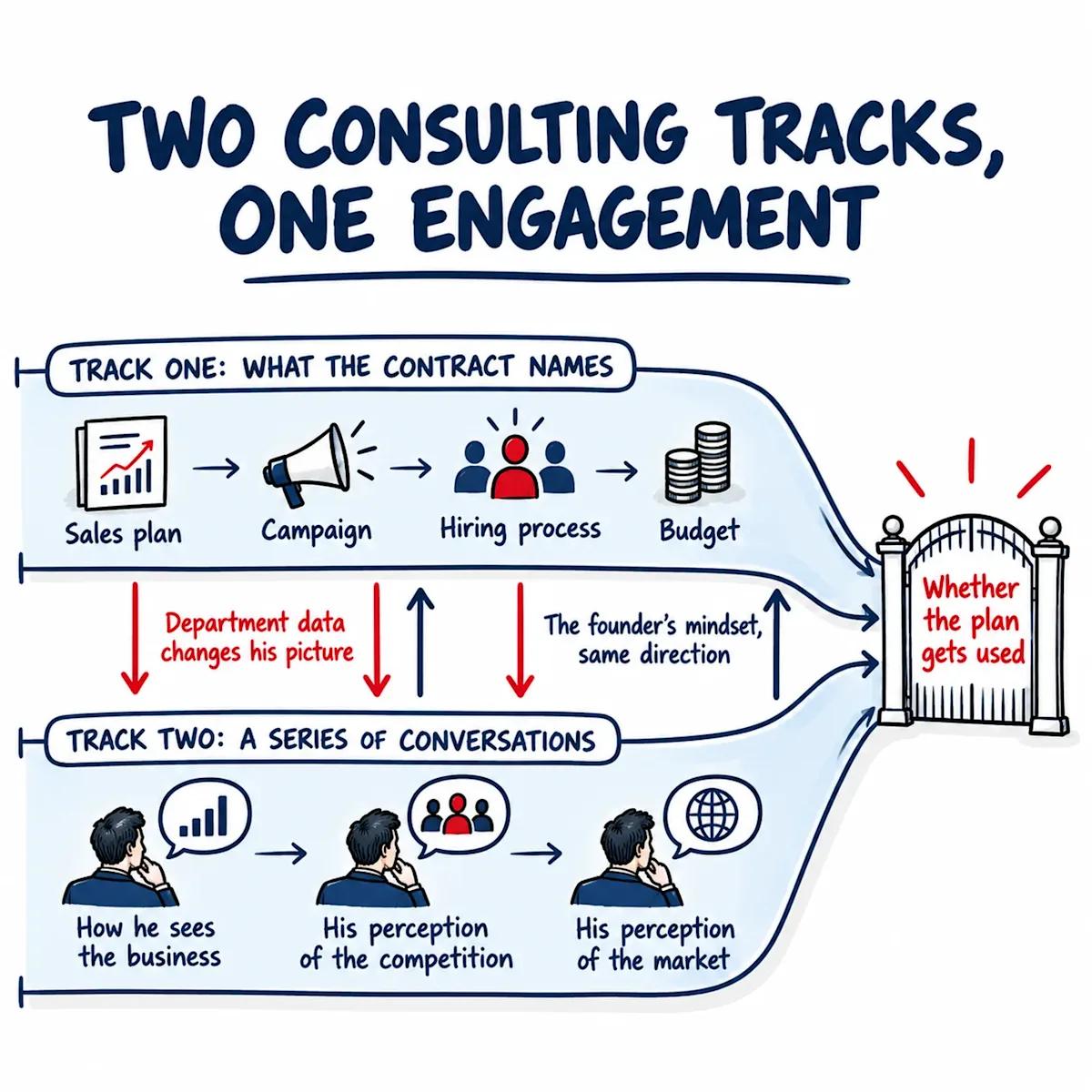
In October I was at a consulting event with more than 20 consultants in the room: marketing, sales, HR, finance. One by one they talked about how good they are in their own department. Then I asked them how many of them work on the founder, on how he thinks and how he sees his own company. The answer was none.
So when you hire any of them, you get department work: a sales plan, a campaign, a hiring process, a budget. Nobody in that room had been hired to work on the person who decides whether the plan gets used. And that person is you.
Here is the part most owners don't like to hear, so I'll say it the way I say it in the meetings. However many consultants you point at your departments, if you don't admit that you need to change as well, the consulting engagement will fail. A consultant can help you in a department. But if you are not willing to change how you see your business, every plan lands on the picture you already hold, and your company implements it halfway, or not at all.
It is not your fault, and it is still yours to change
None of this is a fault. You have worked inside your business for years, and from the inside nobody can take a step back. You see your company, your competition and your market from the same place you have been standing all these years.
Most owners come to me with a sales problem. Most of the time it is not a sales problem, and in most cases it is the owner. His work is rarely the problem, he usually works harder than anyone in the company. His picture of the business is.
In July 2024 the owner of an IT field-services company in New York asked me for "a lead generation system that can churn on its own". While we were looking at his offer, I told him: "here you're not really an IT guy. You are a recruitment agency". He sends his technicians to IT companies that do the same work at a bigger scale, and he was selling himself as one more IT company. No lead system would have fixed that. He had to see his own company differently first, and only then did the sales work have something to stand on.
One third of the orders, about 6% of the revenue
Sometimes the change comes from the numbers, if somebody puts them in front of you.
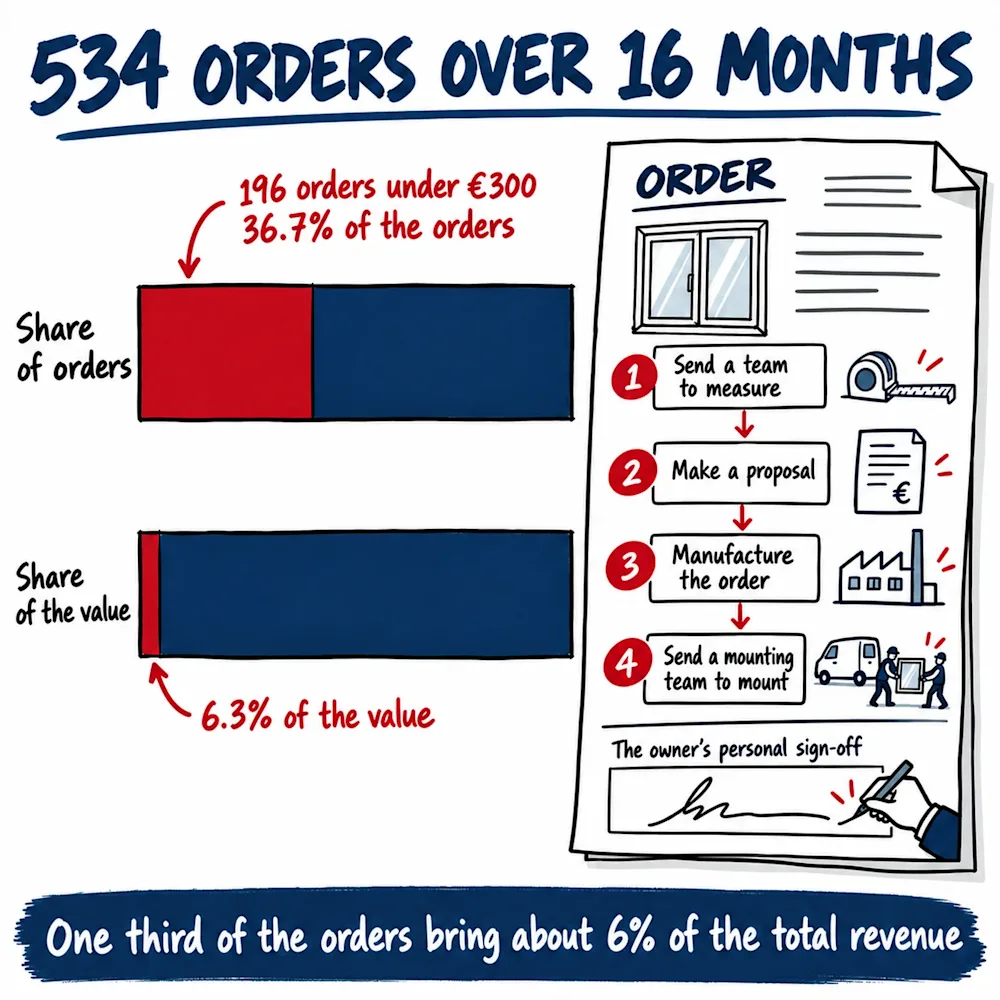
On a diagnostic for a PVC window manufacturer we went through the owner's 534 orders over 16 months. 196 of them were under €300. That is more than a third of all his orders, and together they brought in 6.3% of the value. Every one of them made money on materials, so this was never a loss. It was his time. Each of those orders needed his personal sign-off before production could start. For under €300, sometimes even €50, his company sent a team to measure, made a proposal, manufactured the window and sent a mounting team to mount it, and he kept all of it moving, on the phone and in the schedule with the client.
He had signed every one of those orders himself. And still I watched his face change when he saw them together. What the table showed him was where his own days were going.
Four founders, and the moment the picture moved
The PVC owner found it in a table. Most owners find it in a conversation. Here are four, and what each of them came for.
A founder was building AI accounting software and was deciding which features to add to compete with QuickBooks and a few others. He came for a product question. I asked him how hard it is to convince an accountant who has used the same software for five years to switch to his. Then I asked him to read his own interviews with accountants again, "with a switched mindset". During that call he saw that he does not have to fight the giants. He needs something that sits on top of them. His words: "I don't need to convince them to switch. I just need to convince them to upgrade."
A founder in the UK had built AI for construction businesses. He came with about 7,000 cold emails sent and no replies. In our conversations I found out that he had run a construction business himself, from labourer to about 80 people at one point, and there was no mention of it anywhere on his own website. He was shy about it. I told him: "You're sitting on a gold mine, but you're not aware." And about the people he sells to: "It's not about the tenders. It's about the weight on their shoulders." He had carried that weight himself. After our conversations he made his past his selling point. What he was hiding was the reason to buy from him.
Two people behind an online fitness platform sent me their plan: workout programmes half made, influencers on commission, brand ambassadors, affiliates, and an idea to sell subscriptions to companies for their staff. The one thing they said was missing was market research. I didn't answer any of their questions. I asked them to put everything on one board first, because without a map they would keep jumping from one idea to the next. Two months later one of them wrote to me that "the ability to extract us from our personal point of view and see our business from a bird's perspective was a game-changer".
Each of them came for something in a department: leads, features, emails, research. In each case the first thing that moved was the founder.
What those conversations look like
It is a series of meetings, sometimes one is enough and sometimes it takes several, and that depends on how open you are to change. A meeting runs about an hour. You talk about your business, and I challenge your assumptions and your logic. While I challenge them, I show you angles and opportunities you have not thought about, even though you have been in the industry for years.
I ask, and you answer out loud. An answer you give yourself stays with you; an answer a consultant hands you usually ends up in a folder. Between the meetings there is homework, and most of the thinking happens there. The result is a different picture of your own business, and you are the one who names it.
The way owners usually leave tells me if it worked. They say: "I am not going to sleep tonight. This new perspective opens so many new opportunities that I need to think about."
A few questions, this time about you
- How many plans have you paid for that your company implemented only halfway, and whose decision were they waiting on?
- When a consultant's findings were right and the change still did not happen, who resisted it, and how sure are you it was not you?
- In your last consulting engagement, how many hours did the consultant spend with your team, and how many with you?
- How would you describe your competition today, and when did someone last challenge that picture?
- Which orders, clients or approvals in your company still wait for your signature, and when did you last count them?
If one of these questions stayed with you, notice what just happened. Nobody handed you a report. You were asked, and you answered about yourself, in your own head. That is where the change starts, and it is the one part no consultant can do for you.
If you want to test how you see your own business first, the Clarity deep dive asks 30 questions across six areas, money, customers, cash, growth, decisions and your market, and shows you where you're guessing, where you're blind, and what to check first. And when you want someone to follow the evidence wherever it leads, your own chair included, that is what the Business Pulse diagnostic does, in 30 days.