Your Company Uses AI. Here Are the Three Levels You Have Not Reached Yet.
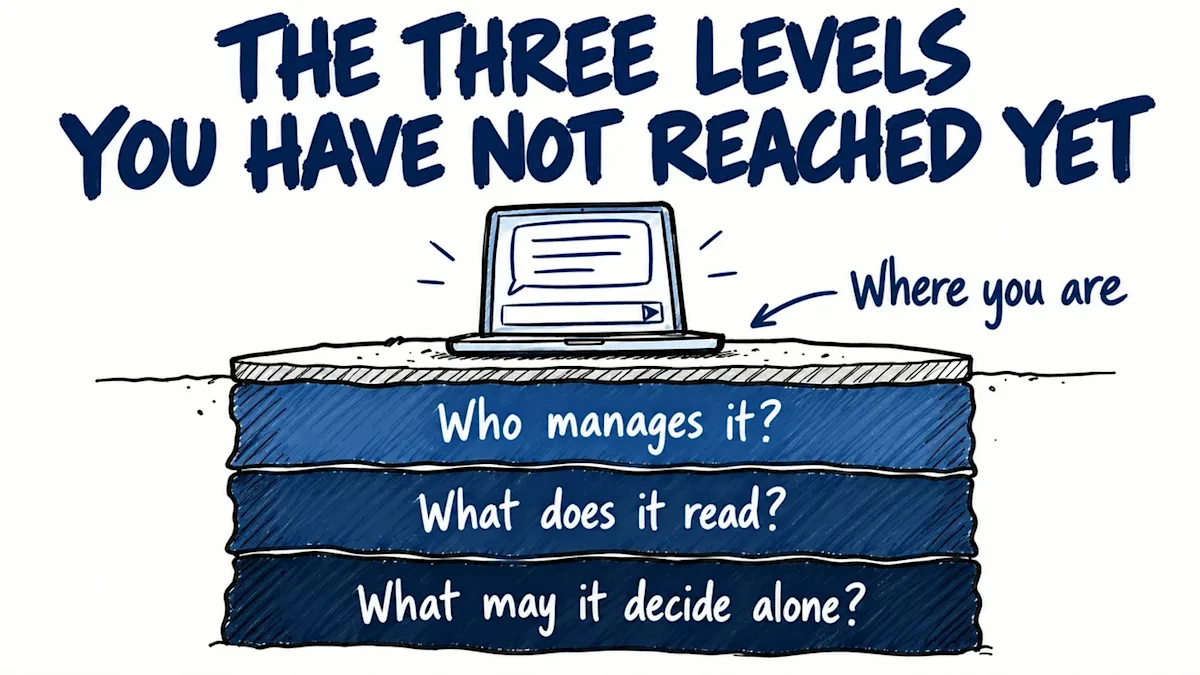
You use ChatGPT and you say your company already uses AI. That is the first of four depths, and the shallow one. Here are the other three, what a company looks like at each, and the problem each one brings, a problem that nobody in a company your size is paid to solve.
Last night you opened ChatGPT and asked it about your market. Twenty minutes later you had your competitors, their prices and a page of advice on your own pricing, work that used to take someone in your company a week. The subscription is €20 a month. And somewhere this month you have said it out loud: we are already using AI in our company.
You are right about the research. The part you are wrong about is the word "already". What you have is the first of four depths of AI in a small company, and it is the shallow one. The other three exist whether you have heard of them or not. Other companies are already there, and each depth brings a problem that nobody in a company your size is paid to solve. You will not see those problems coming from where you stand, because from depth one each deeper level looks like more of the same thing: a better tool.
Here are the four depths, and the problem that arrives with each one.
Depth one, where you are: AI as a faster way to work
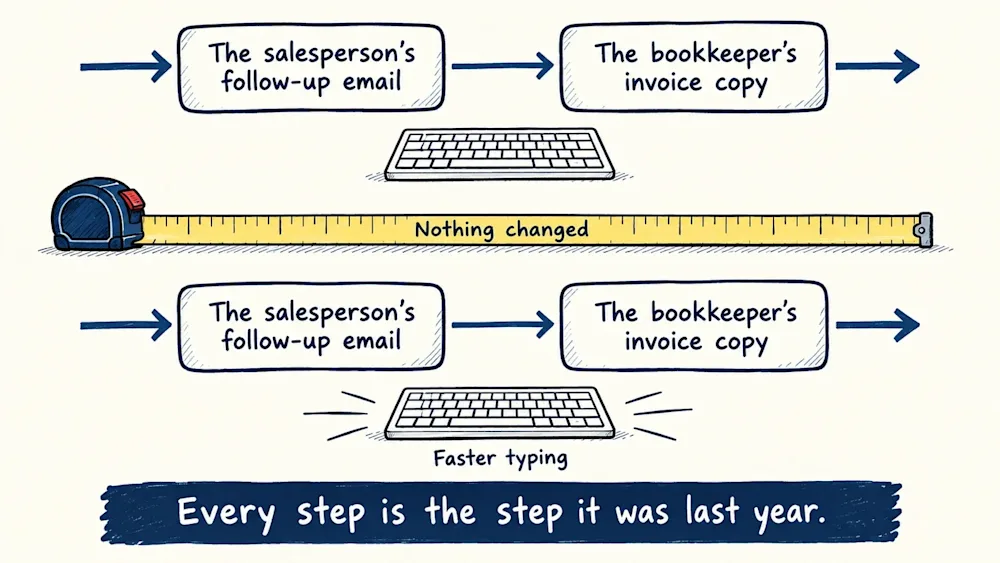
Depth one is the one you know. You pay for the accounts, you tell everyone to use ChatGPT for everything, and after a few weeks the office is quieter and quicker. The salesperson writes his follow-up email in two minutes instead of ten. The bookkeeper gets a summary of a contract instead of reading twelve pages. Your market research is done over coffee.
Depth one has a quiet problem: it pays back the €20 a month many times over and changes nothing underneath. Walk through the office and look past the screens. The salesperson still decides who to write to and when; ChatGPT only types the email. The bookkeeper still opens both programs and moves the invoice across; ChatGPT only does the reading. No step has gone, no handover has moved, and the same person sits at each desk with a faster keyboard. Every step in your company is the step it was last year, done with faster typing. It does not hurt yet: everybody is faster and nothing broke. When you say "we are already using AI in our company", you are right, and what you have is a company with faster typists. At the next three depths the machine starts doing the work itself, and the problems stop being quiet.
Depth two: AI as a digital employee
At the second depth AI stops answering your questions and starts doing a piece of the work on its own. The name for that is an AI agent: a program that does not wait to be asked. It watches for something to happen, does its step, and hands the result to the next person or the next program. A digital employee is an agent with a place in your team. It reads the new orders every morning and flags the odd ones. It writes the first reply to every enquiry. It chases the unpaid invoices on day thirty. The picture that gets owners excited is a company of 25 people and 25 agents, where the owner no longer hands out tasks but runs the whole system.
Here is what it took in my own company. Before anything was built, we drew how one of our sales channels really works, step by step, the way the people doing it actually do it, not the way the old document said. Our six or seven steps came out as ten, holding 113 separate activities, and only then did we know which of them a program could take. When code and AI had taken the work, a person was still needed at four places: the first call with a possible client, the approval of the proposal, the kick-off call and the approval of the contract. The AI did not pick those four places. Someone had to walk the whole map and ask, at every step, where a person still has to be.
At depth two the problem lands on your team. The moment an agent takes a piece of the work, somebody has to decide which piece, who it hands over to, who checks it, and how anyone knows it did a good job this month. For a person you have a job description, a manager and a yearly review. For an agent you have none of those, and no HR book covers one. In a company your size nobody has that job. The agent arrives on a Tuesday, and the roles, the handovers and the measures do not arrive with it.
Depth three: AI as your second brain
The third depth leaves your team and comes to your own desk. At depth one you asked ChatGPT about the market. At depth three the AI sits beside you for the decisions: it reads your sales and your costs, plays out what happens if you open the second shop or raise your prices, flags the risk you did not ask about, and recommends what to do, at eleven at night as easily as at nine in the morning. Call it a second brain: better questions, better decisions.
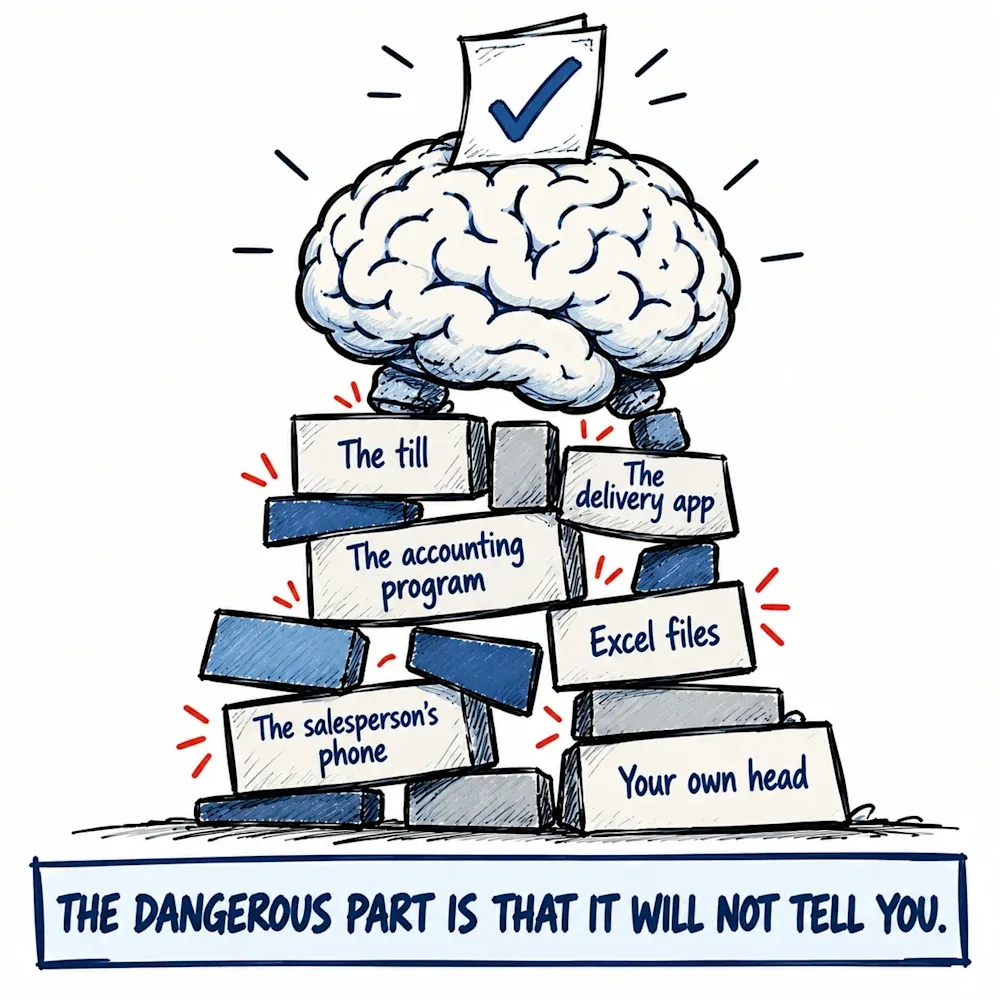
Here the problem is what goes in. The assistant answers the question you ask. Ask it why sales are down, and it tells you why sales are down, even when the real question is why your three best customers stopped ordering. And it reasons on the data you give it. Give it one export from the accounting program, and it reasons on one export. In a company your size the numbers sit in ten places: the till, the delivery app, the accounting program, a few Excel files, the salesperson's phone and your own head. Nobody has ever put them in one place where they agree with each other, because until now nobody needed to. A base of data, one set of files that give the same numbers every time they are read, does not exist in your company yet, and the assistant is useless until someone builds it.
The dangerous part is that it will not tell you. An AI writes a confident answer to a weak question as readily as to a good one, and a confident answer built on one export looks exactly like a confident answer built on the whole company. At depth one a wrong answer costs you a bad email. At depth three it costs you the second shop.
Depth four: AI in the leader's chair
The fourth depth is the one you have read about in the headlines. NetDragon Websoft, a gaming company in China, named a humanoid robot the rotating CEO of a subsidiary, and Dictador, a spirits brand, named a robot called Mika its CEO and kept hiring and firing with people. Neither is coming to a company of 20 people this year. What is coming is the smaller version: the machine that watches the operation while it runs, plans ahead of it, and acts on its own inside limits that people set, the small decisions first. People keep the ethics, the culture and the direction of the company.
You will get there sooner than you think, and not because a robot will sit in your chair. It is a habit. The owner who has a second brain starts asking the machine before he asks anyone in the building, and one day he lets it act on the answer without reading it first.
Nobody has written the limits. That is the problem at depth four. What may the machine decide alone? Where does your signature still have to be? Who checks what it did last week, and would they know what to look for? A corporation answers those questions with a board, a compliance department and a policy for almost everything. A company your size has never had a governance document, which is only the written rules of who may decide what, because until now everyone who decided anything sat in the same room as you. Now there is a member of the team that never sleeps and never doubts itself, and no page anywhere says what it is not allowed to do. Someone has to write that page before the machine makes the decision you would have wanted to make yourself.
One question, about your desk
By now you know which depth your company is at. If the honest answer is depth one, with one toe in depth two, that is a fine place to be. The question that decides the next two years is a different one: is the problem of the next depth on anyone's desk in your company, by name? Ask it at your next team meeting. If the answer is a silence, the silence is the answer. That does not mean anything is wrong, only that the problem has not been given to anyone, and the three problems beyond depth one are not the kind that solve themselves.
The Clarity deep dive is free: 30 questions on money, customers, cash, growth, decisions and your market, about eight minutes, and you leave your email at the end and get the full report right away. When you want that answer tested against your own records, the Business Pulse diagnostic takes 30 days: you open your financials, sales records and contracts, sit in two meetings, and get a report with a prioritised action plan, every action with an owner and a timeline.