The Question You Can't Answer About Your Own Business Is the Most Important One
Try to answer a simple question about your own company and you may find you can't. That gap is not an admin annoyance - it is the most important finding about your business, because what you cannot see, you cannot steer. Here is how to read it, and where to start.
Sit down for a moment and try to answer one question about your own business. Which of your customers actually make you money - not which ones are biggest, which ones are profitable once you count the real time and cost to serve them? Now try another. How many months could you keep paying everyone if your three largest clients all paid late at once?
If you can answer both in a couple of minutes, with numbers you trust, this article is not for you, and well done. If you cannot - and most owners cannot - keep reading, because that gap is far more important than it looks.
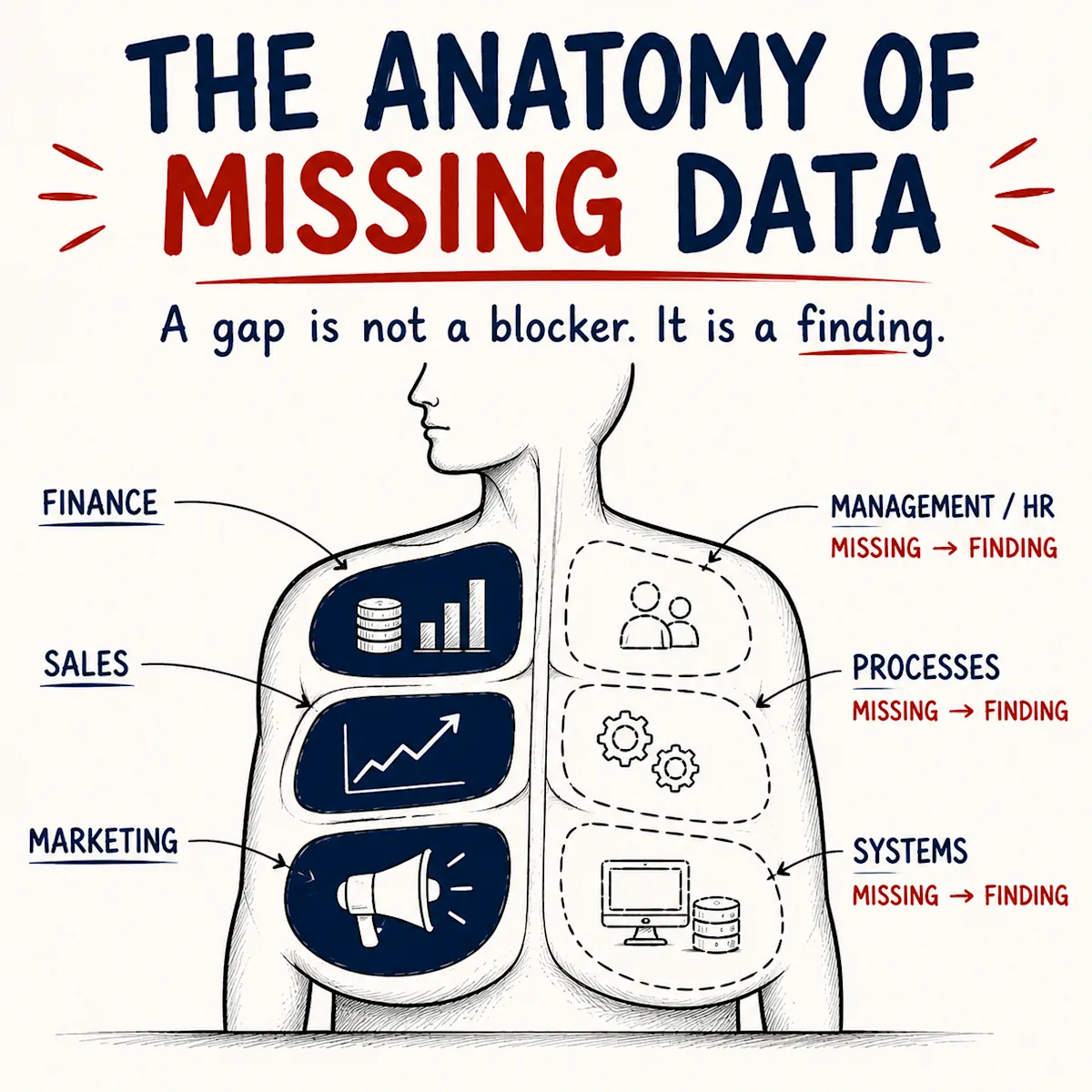
When you cannot answer a basic question about your own company, the instinct is to feel a little caught out and move on. You have run the business this long on instinct, and it has worked. But here is what I have learned from running diagnostics on company after company: the questions you cannot answer are not a hole in your paperwork. They are a finding about your business. What you cannot see, you cannot steer - and a number you do not have is usually pointing straight at the place you are most exposed.
A gap is not a blocker. It is a finding - about where your business is flying blind.
The five-question test
Here is a quick way to feel it. A healthy business should be able to answer each of these in minutes, from data it actually keeps. Read them slowly and notice which ones make you reach for a guess.
- Are we profitable on paper but tight on cash in practice - and do we know exactly why?
- Which of our products or services actually make money, once we count the real cost of delivering them?
- If I were unavailable for thirty days, would the business keep running - and who would make which decisions?
- If our biggest supplier failed tomorrow, do we have a plan B?
- We say "everyone is our customer" - but who actually is, by revenue and by profit?
If two or three of those made you pause, that pause is the finding. It is not that you are doing a bad job - it is that the business has grown faster than the instruments you use to see it. That is normal. It is also exactly the thing that quietly caps how big and how calm a company can get.
Missing data comes in two flavours
And they mean different things, so it is worth knowing which one you have.
You have it, but cannot get to it. The number exists somewhere - a spreadsheet, an inbox, someone's head - but pulling it takes days and arrives in three versions that do not agree. That is an operations problem wearing a data costume. A company that cannot find its own numbers quickly is usually paying for that disorganisation in other places too.
You never had it at all. Nobody ever worked out the margin per product, or tracked where customers come from, because the business never needed it until now. This is the louder one. It means you have been steering by feel on something that has started to matter - and feel stops scaling at roughly the size you are now reaching.
Two businesses - you might recognise one
Let me show you two real companies, anonymised, because most owners see themselves in one of them.
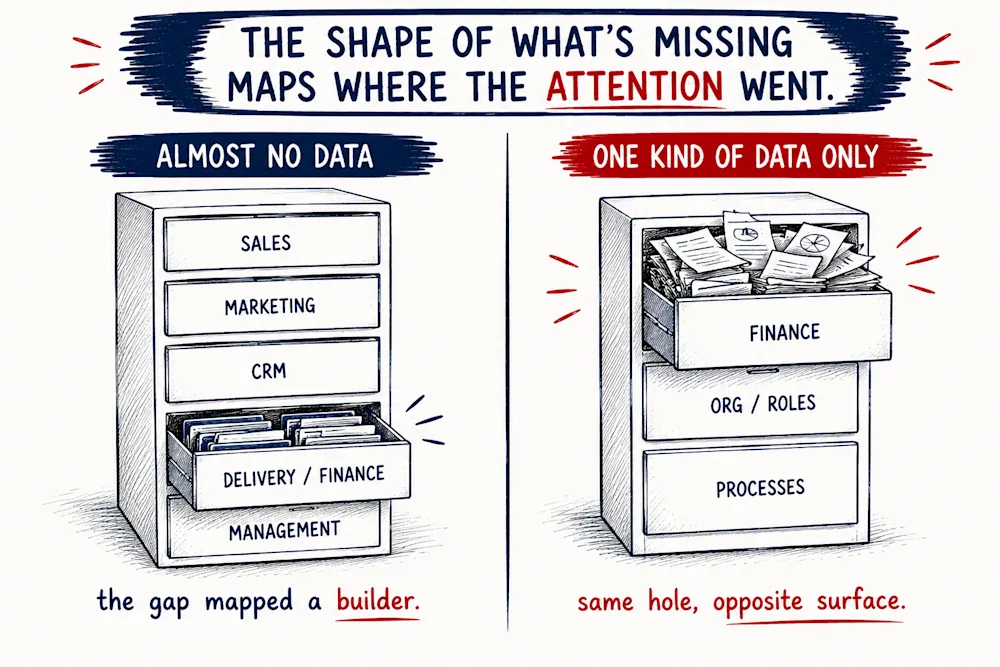
The first was a software company - profitable, talented, busy. But when we went looking for the commercial picture - how it wins clients, its pipeline, its marketing - there was almost nothing to find. No customer database, no sales process, no marketing to speak of. The owner was a brilliant builder who had poured himself into the product and never built the business around it. The missing data was the diagnosis: a superb workshop with no engine for growth. Which was exactly why most of its revenue had quietly concentrated into a handful of clients it could not afford to lose.
The second looked like the opposite. A fast-growing restaurant, buried in data - every invoice, every delivery order, every cost, tracked to the cent. But ask who was responsible for what, where the processes were written down, what the roles and targets were, and the room went quiet. There was no management structure at all. The place ran entirely on the founder's energy and the kitchen - which is precisely the thing that breaks when a business grows.
Two opposite companies, the same lesson: the shape of what they could not show us mapped exactly where each had been pointing its attention, and where it had not.
Why this is the thing to fix first, not last
It is tempting to file all this under "nice to have" - get through the busy season, then tidy up the data. That is backwards. The blind spot is almost always upstream of the problem that is actually bothering you. The software company's client concentration was not a sales issue to patch; it was the direct result of having no growth engine. The restaurant's daily stress was not a staffing issue; it was the absence of any management structure. Fix the symptom and it grows back. The gap is where the real fix lives.
You can use AI to start answering these
Here is some good news: you do not need a finance department to begin closing these gaps. AI tools are genuinely useful here - you can point one at your own numbers and start getting answers to questions you have never had the time to work out. For an owner, it is the fastest way there has ever been to start seeing your business clearly.
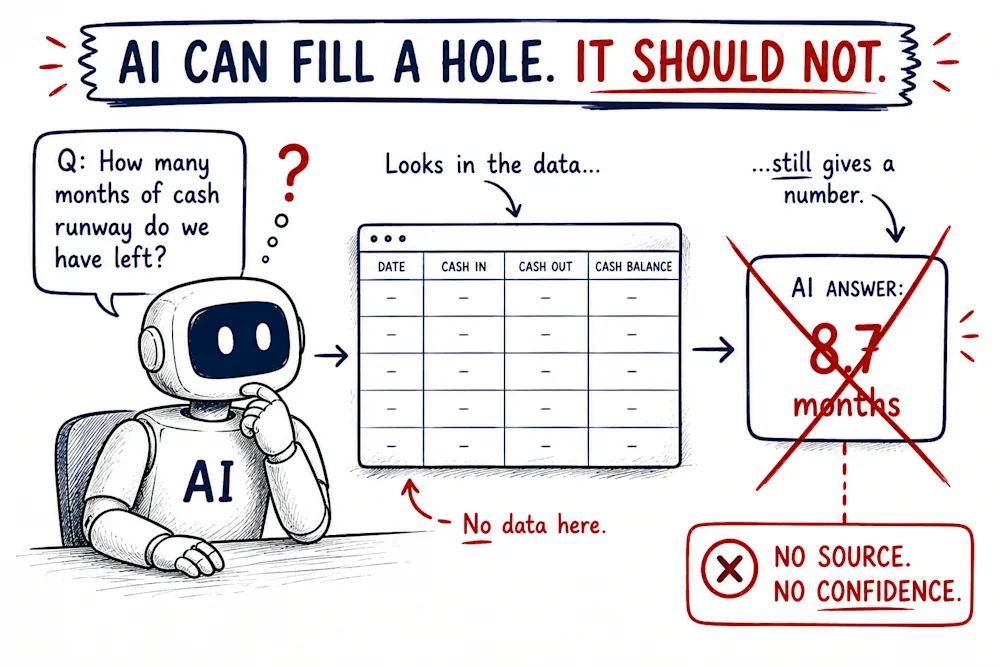
Two gentle cautions, and then I will leave it. AI can only answer from data you actually have, so it will not conjure a number you never tracked - the gap is still the gap. And if it does hand you a figure, make sure it is calculated from your real numbers and can show its source, rather than invented to fill a silence. We wrote about that exact trap in why AI gives businesses the wrong number, confidently. Used with that bit of care, it is a real head start.
What to do next
So here is the exercise, and it takes ten minutes. Write down the three questions about your business you most wish you could answer instantly - the ones that would change a decision this quarter. Then try to answer them from the data you have today.
The ones you cannot answer are not a to-do list for someday. They are your most important findings, and they are where to start.
That is exactly what a Business Pulse diagnostic is built to do - not to bury you in a report, but to find the handful of blind spots quietly costing you the most, and turn "we think" into "we know." If you want to see how we decide where to dig first, here is how to know which kind of diagnostic your business needs.
So, the real question: what can't you answer about your own business right now?