Never Show a Customer Just One Price
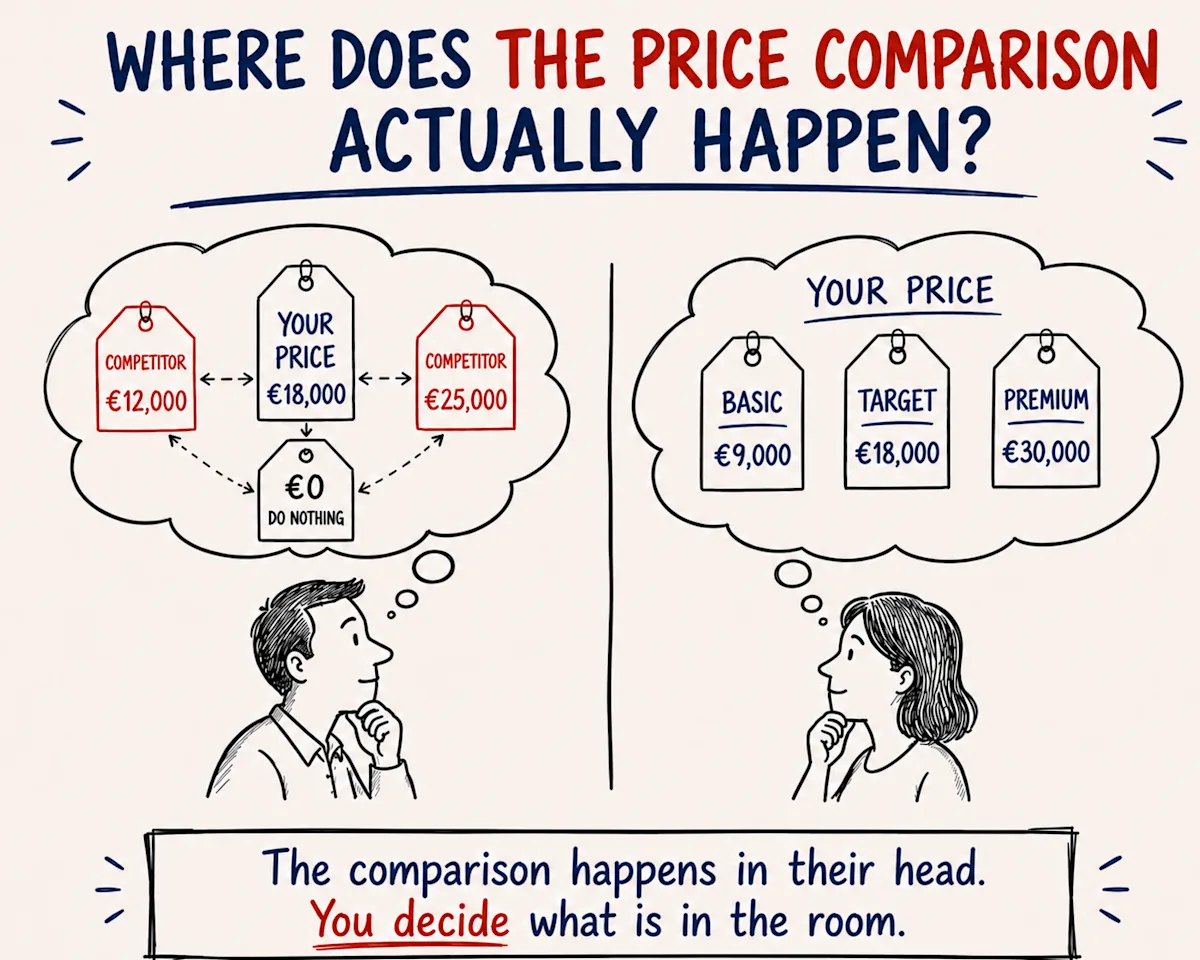
When you send a customer a single price, you lose control of what they compare it to. They stack it against a cheaper rival, or against doing nothing, and you are not in the room for that decision. Show three of your own prices instead and the comparison quietly changes: now they are weighing you against you. Here is how three prices, built the right way, make your best offer the obvious one.
You are about to send a quote. The cursor is blinking next to the number, and you do the thing almost every owner does: you type one price and hit send. Then you wait, and you hope it lands.
Here is what happens the moment that single number arrives. Your customer does not judge it on its own. Nobody does. They judge it against whatever is sitting next to it in their mind, and because you gave them only one number, they get to choose the neighbours. Usually they pick the worst possible two: a cheaper competitor they half-remember, and the oldest rival of all, doing nothing at all. Your one brave price stands there alone, against both.
You cannot stop a customer from comparing. It is simply how people decide. But you can decide what they compare you against. And that changes everything.
The famous example nobody forgets
Years ago, The Economist sold subscriptions three ways. Online only for 59 dollars. Print only for 125. And print plus online, also for 125.
Look at that middle one. Print alone for 125, when the same 125 gets you print and online together. It looks like somebody made a mistake. Who would ever buy it?
Almost nobody did. And that was the whole point. When people saw all three, most chose the print-and-online bundle, because next to that pointless print-only option it looked like an obvious win. When the "useless" option was removed and people saw only two, far more of them drifted to the cheap online-only one. The option nobody bought was not a mistake. It was quietly doing a job: making the option beside it look like the smart choice.
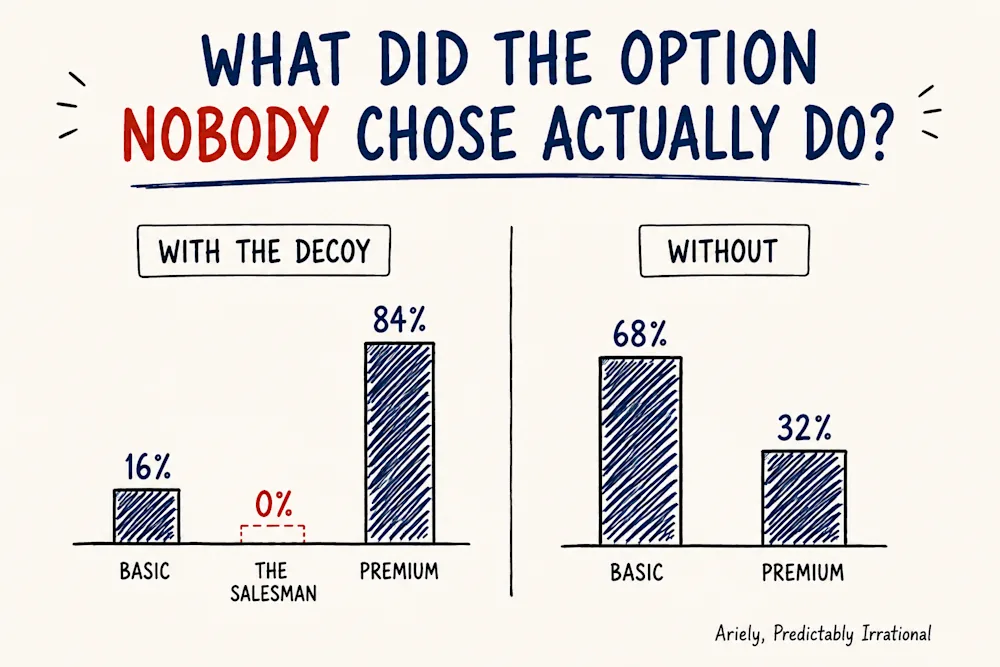
That is the quiet mechanism behind almost every three-price menu you have ever seen. And you can use it in your own business, honestly, without tricking anyone.
The one rule
Here is the rule underneath it: an extra option never sells itself. It sells the option next to it that clearly beats it.
So pricing is not really about the numbers first. It is about this: decide which of your offers you actually want most customers to buy, and then build it a neighbour that it beats without any argument. Put the two side by side and let the customer see, for themselves, which one is the better deal. You are not pushing. You are arranging.
There are two ways to build that neighbour, and they look like opposites.
Make a neighbour that loses on value. Take the offer you want to sell, and next to it put a slightly cheaper option that gives up far more than it saves. A little less money, a lot less inside. When the customer compares the two, the fuller offer wins on sight, exactly like the print-and-online bundle did. Use this when your customers are careful, the type who read every line and want to feel they got the best deal. You are handing them a comparison they can win.
Make a neighbour that loses on price. The mirror version. Above the offer you want to sell, put a much more expensive option that adds only a little. It sits at the top looking grand and slightly silly, and hardly anyone buys it. That is fine, because it was never meant to sell. Its job is to make your real price look reasonable by comparison. Use this when the price is the thing that scares people. You cannot argue someone out of thinking your price is high, but you can put a higher number next to it and let your real price become the sensible middle.
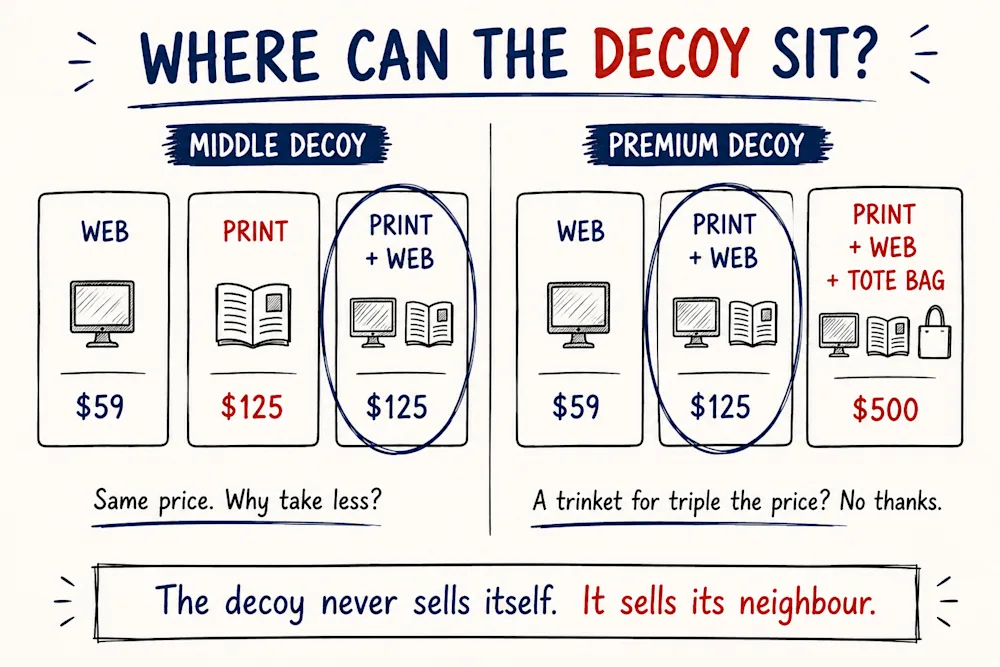
Same trick, pointed two different directions. Either way, the customer compares you with you, and lands where you hoped.
The third price: your honest floor
If one price is your target and one is the neighbour that sells it, what is the third? Your floor. The smallest real version of what you do, stripped back to the essentials but still genuinely worth buying. This one is not a trick. It is a true offer for the customer whose budget really is tight, and it does three quiet jobs: it makes saying yes easy, it welcomes the smaller client instead of turning them away, and it holds down the bottom of your range so the rest has somewhere to stand.
Three prices, three jobs. The floor that opens the door. The target you actually want to sell. And the neighbour whose only job is to make the target obvious.
One warning. Three is the number, not ten. One price gives the customer nothing to compare, so they invent their own comparison and it is rarely in your favour. Too many prices do the opposite and freeze them, because a confused mind does not buy. Three is enough to guide, few enough to decide.
And when they ask for a discount
They will. Someone will love the offer, then say the budget is smaller than the price. The instinct is to knock money off to save the deal. Resist it.
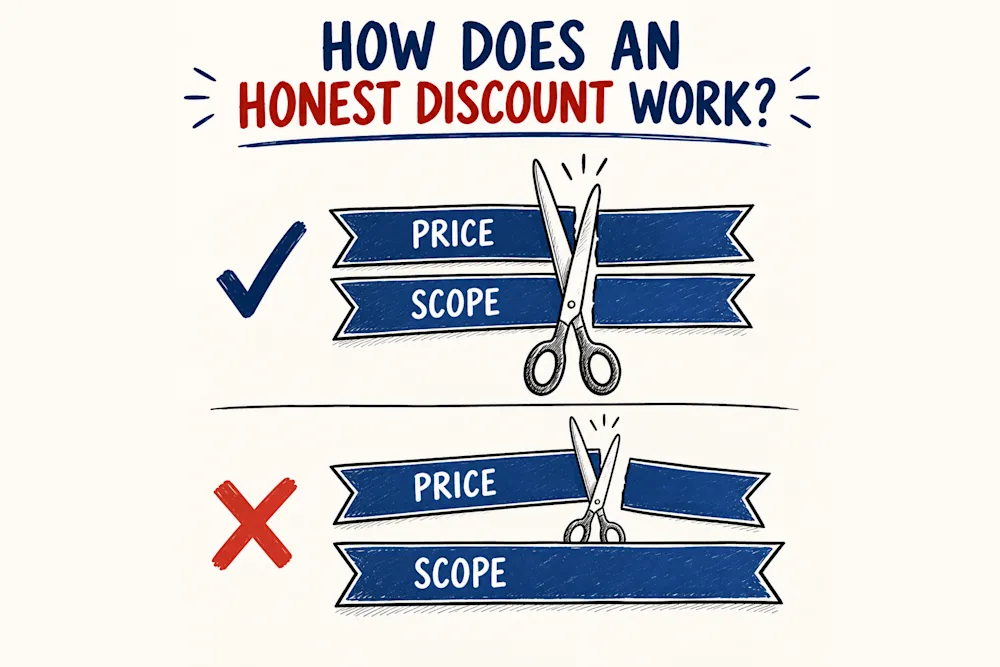
A bare discount quietly tells the customer your first price was never real, and it teaches them, and everyone they talk to, to always push for less. Do it the honest way instead: when the price comes down, take something out of the box with it. Less money, less scope, together. The customer still gets to their budget, your price keeps its meaning, and often, watching what leaves the box, they decide the full thing was worth it after all.
Where to start
You do not need to redesign everything this week. Take the one offer you sell most, the thing you quote again and again as a single number. Give it two companions: a stripped honest floor beneath it, and a neighbour built to make it shine. Then send three prices where you used to send one.
You are not manipulating anyone. Every option is real and really delivered. You are just refusing to let your best offer stand alone in a comparison you did not choose. Let them compare you with you.
Which of your offers have you been sending out as a single, lonely number?
Pricing is one of those decisions that quietly shapes everything else in the business, and it is rarely the only one hiding in plain sight. At Business Pulse, a business diagnostic looks across your whole business to find the handful of quiet decisions, pricing among them, that are holding back growth, so you fix the ones that actually matter. If you want a first look at where your own business stands, the free business health check takes about four minutes.