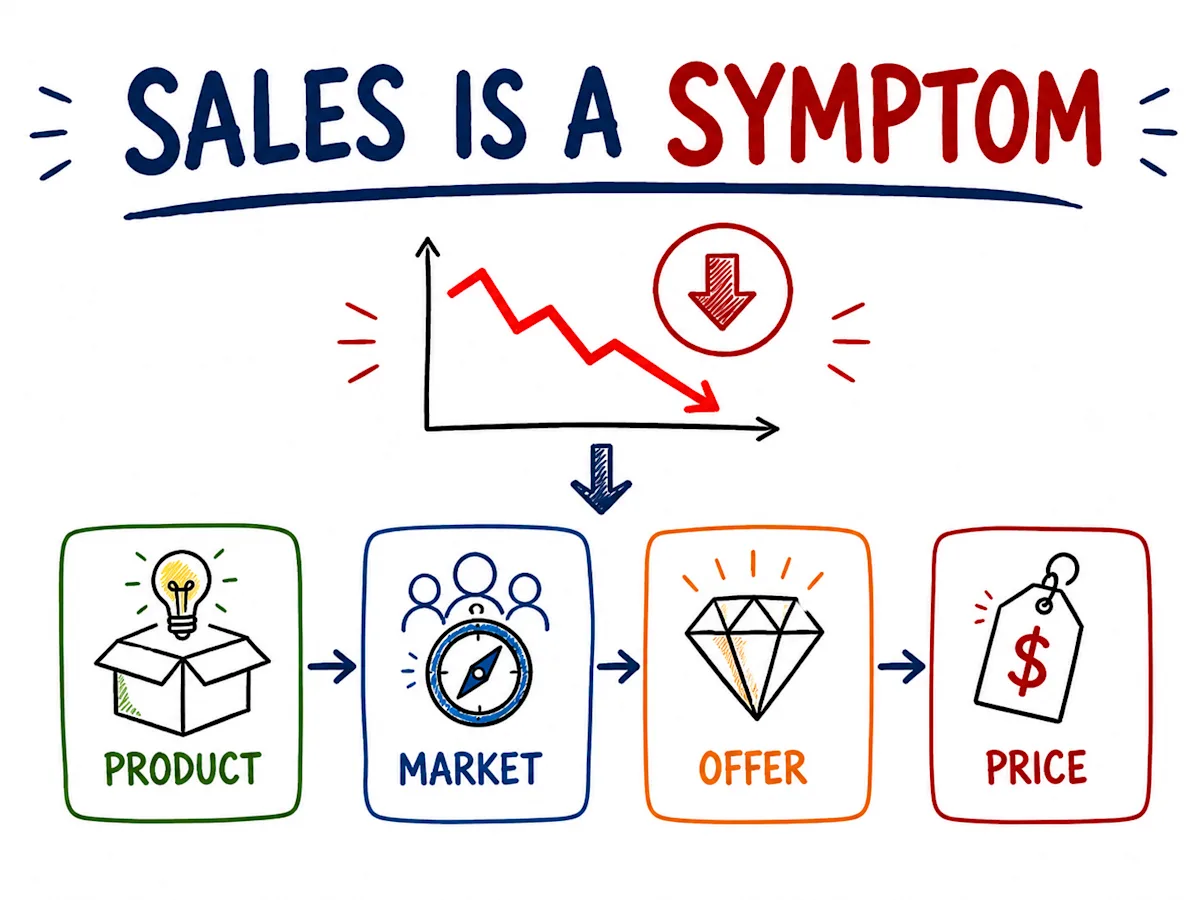
More Sales Won't Save a Broken Business. It Just Breaks It Faster.
When sales dip, most owners do the same thing: spend on marketing or hire a salesperson. If the business underneath is healthy, that works. If something is broken, it is the most expensive move you can make, because selling more of a broken business just breaks it faster. Here is how to tell the difference before you spend a cent.
Sales have been soft for a few months. Not a cliff, just a steady drift downward, enough that you feel it in the bank account and again at two in the morning. And the instinct arrives, the same one every owner gets. I need to sell more. So you start pricing up an ad campaign, or you open a tab to post a job for a salesperson.
It feels like taking control. It is often the most expensive mistake you can make.
Here is the thing about selling more. If the business underneath is healthy, more selling works, so go and do it. But if something is actually broken, spending to sell more does not fix the break. It pours fuel on it. You move a broken product faster, usually at a discount, and you end the quarter poorer and no closer to the real problem. More sales of a broken business is not a fix. It is just more broken, faster.
How it usually goes
I have watched this play out more times than I can count, and it almost always follows the same script.
An owner sees sales sliding and decides the answer is more leads. Real money goes into ads. And the ads work, in the narrow sense: the enquiries come in. But they do not turn into customers. Or the ones that do only sign after a discount. Or they leave within a few months. The owner spent the money, got busier, and finished the quarter with the same soft revenue and a lighter balance.
The ads were never the problem. They just delivered more people to an offer that was not landing, and made the leak look like a win for a few weeks. The money did not fix the business. It bought a louder version of the thing that was already going wrong.
Why selling harder cannot fix it
The reason is simple. Sales is a mirror. It reflects the health of everything standing behind it: the product, the market, the offer, the price. When the reflection looks wrong, hiring a better salesperson is polishing the glass and wondering why the picture does not change.
The best salesperson alive cannot sell a product people have quietly stopped wanting. The best ads in the world cannot rescue an offer nobody can tell apart from the competition. Selling harder does not change what the mirror is reflecting. It just shows more people the same picture.
Four questions before you spend a cent
So before you approve a budget or post that job, run four questions on the business. Not one of them is about sales. Every one is about what your sales are reflecting.
Does your product still solve a problem people care about today? Not whether it is good. Whether the problem it solves still keeps someone up at night. The must-have of three or four years ago quietly slides into a nice-to-have, and no customer writes to tell you the day it happens. Demand rarely disappears, it cools, and a business built for the old temperature keeps running as if nothing changed. Ask yourself honestly: if a stranger met your product for the first time this morning, with no history and no relationship with you, would they still feel the pull to buy, or would they nod politely and move on? When your best customers are all your oldest ones, and every new one is harder to win than the last, that is the market telling you the problem you solve matters a little less than it used to.
Has your market moved while you stood still? Markets do not sit and wait for you to catch up. The customer gets younger, or better informed, or starts their search on a phone instead of a phone call. A competitor quietly redefines what the whole category is supposed to mean, and now you are being compared against something you never built yourself to beat. The uncomfortable question underneath is the one most owners never stop to ask: who is actually buying from me right now, and is that still the person I designed this business for? If the honest answer is "not quite," no amount of selling closes that gap. You are aiming a sharp pitch at a target that has quietly moved.
Is your offer actually different, or is price the only thing left to compare? Be brutally honest here, because this is where most soft sales are really lost. When a buyer cannot tell you apart from the next option, there is only one lever left for them to pull, and it is price. That is a race to the bottom most small businesses cannot win, because someone will always go lower. Differentiation is not a nicer logo or a line on your website. It is a real reason to choose you that survives a side-by-side comparison with your closest competitor. The clearest tell is in your own deals: if they almost always close only after you drop the price, the market is quietly telling you it cannot see the difference you think you have.
Do your prices reflect the value you deliver, or did you copy them from the shop down the road? Most owners never set a price on purpose. They glance sideways at a competitor, or add a margin on top of their costs, and call it a strategy. But a price is a signal as much as a number. Set it too low and you do two kinds of damage at once: you starve the business of the margin it needs to get better, and you quietly tell the market you are the cheap option, which is the last thing a struggling business wants to be. Price is one of the biggest strategic decisions you will ever make, and it is usually made in a hurry, wearing the disguise of a small arithmetic one.
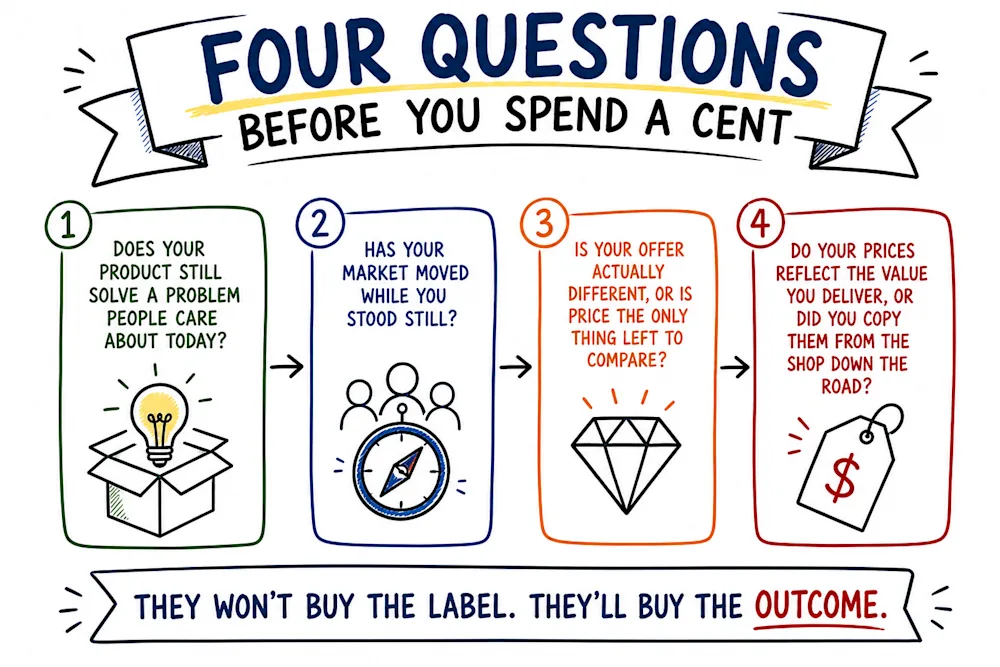
Nine times out of ten, the honest answer to "why are sales down" is sitting in one of those four. Not in how hard you are selling.
Fix the business, then sell
Find the one that is actually broken, and it is usually one, not all four, and fix that first. Then something quiet and powerful happens. The selling starts to work, because now there is something worth selling. The same ad budget lands better. The same salesperson closes more. You did not get better at sales. You gave your sales something real to stand on.
Fix the business, then sell. Do it in that order, and the money you were about to spend finally does what you hoped it would.
Which of the four have you been avoiding looking at?
At Business Pulse, this is exactly where we start, not with "how do we sell more," but with what your sales are actually telling you about the business. Our business diagnostic traces a soft sales number back to the thing that is really causing it, so you spend your money fixing the cause instead of feeding the symptom. If you want to see how that diagnosis works, here is the anatomy of a real business diagnostic.