Did Your AI Pay Off? How to Calculate the ROI on AI in Your Company
Hours saved is the figure everyone has for their AI, and it tells you the least. The return depends on what you bought the AI for: cost cutting, more revenue from the same work, or a new business model. Here is how to count each one.
The renewal for your AI comes up, and before you pay it again someone asks what it gave you. It is ChatGPT, or a tool someone in the team picked, and half the team uses it every day. The only figure anyone can give you is hours: sales says the emails go out faster, the office says the reports are quicker.
And hours saved tells you the least. An hour saved turns into money only when something changes because of it: a person you did not have to hire, a sale that would not have closed, a client paying for something you could not sell before. If nothing changed, the hours went back into the day, and you will not find them on the bank statement.
So before you count the ROI on AI, answer one question: what did you buy it for?
Three answers, three ways to count
ROI is short for return on investment: what the AI brought back, against what it cost you. The cost is the easy half: the subscription, the set-up, meaning the work of fitting the tool to how your company runs, and the hours your team spent learning it.
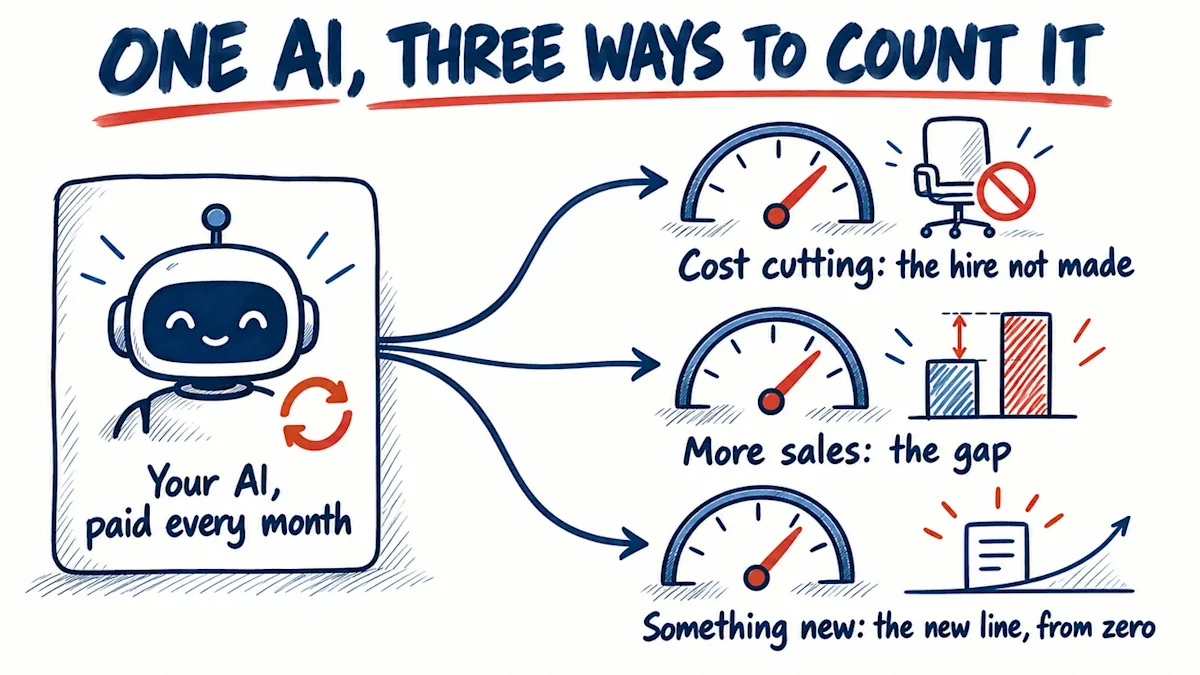
What you bought it for has three answers, and I call each one a route, because each is counted against a different number and checked at a different time. Route 1 is cost cutting: the AI does work you would otherwise hire a person for. Route 2 is more revenue from the same work: the same customers and the same shop, earning more. Route 3 is a new business model: something you could not sell at all before AI.
Route 1. Cost cutting
On this route the return is the person you did not hire. In August 2026 Bartleby, The Economist's business column, wrote in "How to measure returns on AI" that this is the better measure, not the people you let go because AI saved them time.
Before you start, write down your hiring plan: who you were going to hire this year, for which work, at what salary. If there was no hire in the plan, route 1 has nothing to count yet.
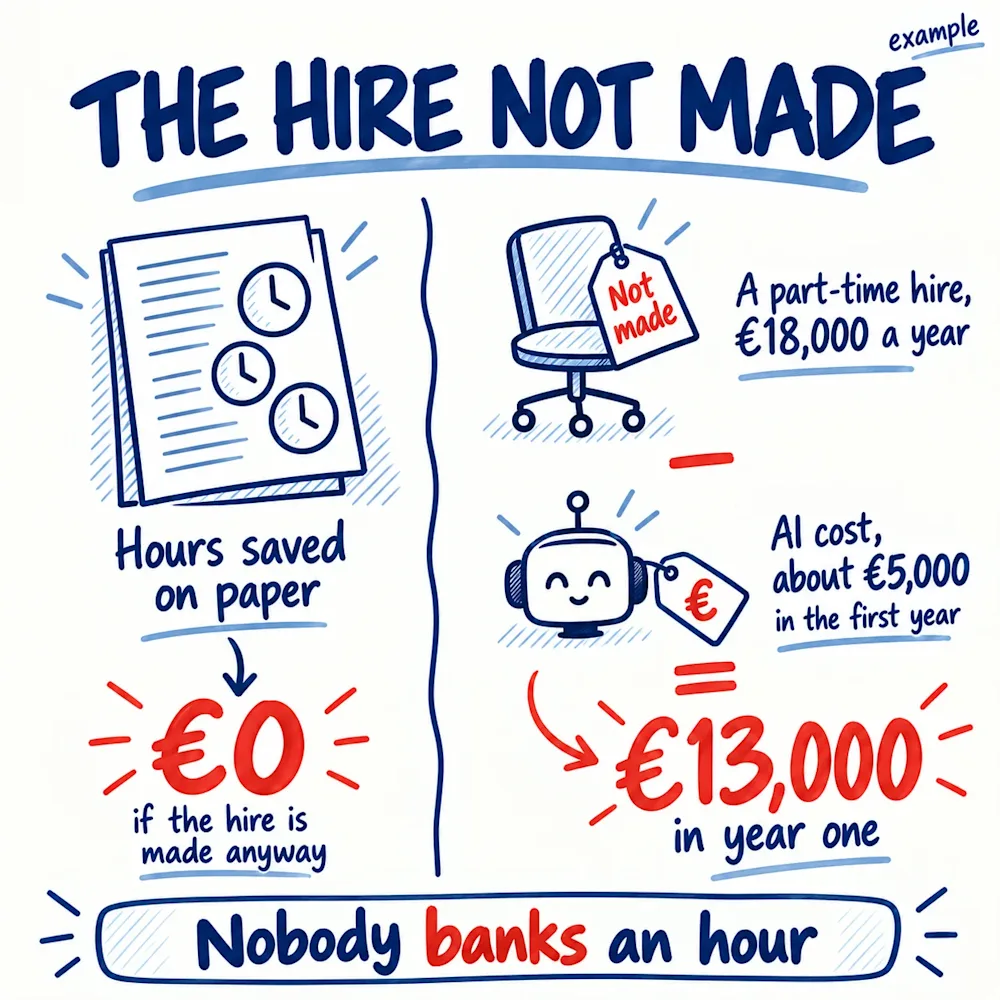
To count it, take the salary of the hire you did not make, and take away everything the AI cost in the same year. Here is an example. A small firm was going to hire a part-time support person at €18,000 a year. Instead it put AI on the support desk, where it answers the first questions customers send, and the AI cost about €5,000 in the first year, set-up and learning included. The return is the hire not made, less the AI cost: €18,000 less €5,000, €13,000 in year one.
Check it month by month. The set-up is paid at the start and the salary is saved one month at a time, so the first months show a loss. The same column points to research on a J-curve: productivity dips while people learn the new tool, and rises after. An owner who checks in month two is looking at that dip.
The trap is the hours. On paper the same AI frees about 900 hours a year, half a person's year, and at €25 an hour that is €22,500, more than the €18,000 salary. But nobody banks an hour: if you hire the support person anyway, the return on route 1 is €0.
Route 2. More revenue from the same work
On this route the AI helps you sell more from the work you already do, for example better emails to the same list of customers. The return is the extra revenue, and the hard part is proving the AI brought it. The same column calls this "even more of an art", and asks for a baseline before anyone claims it.
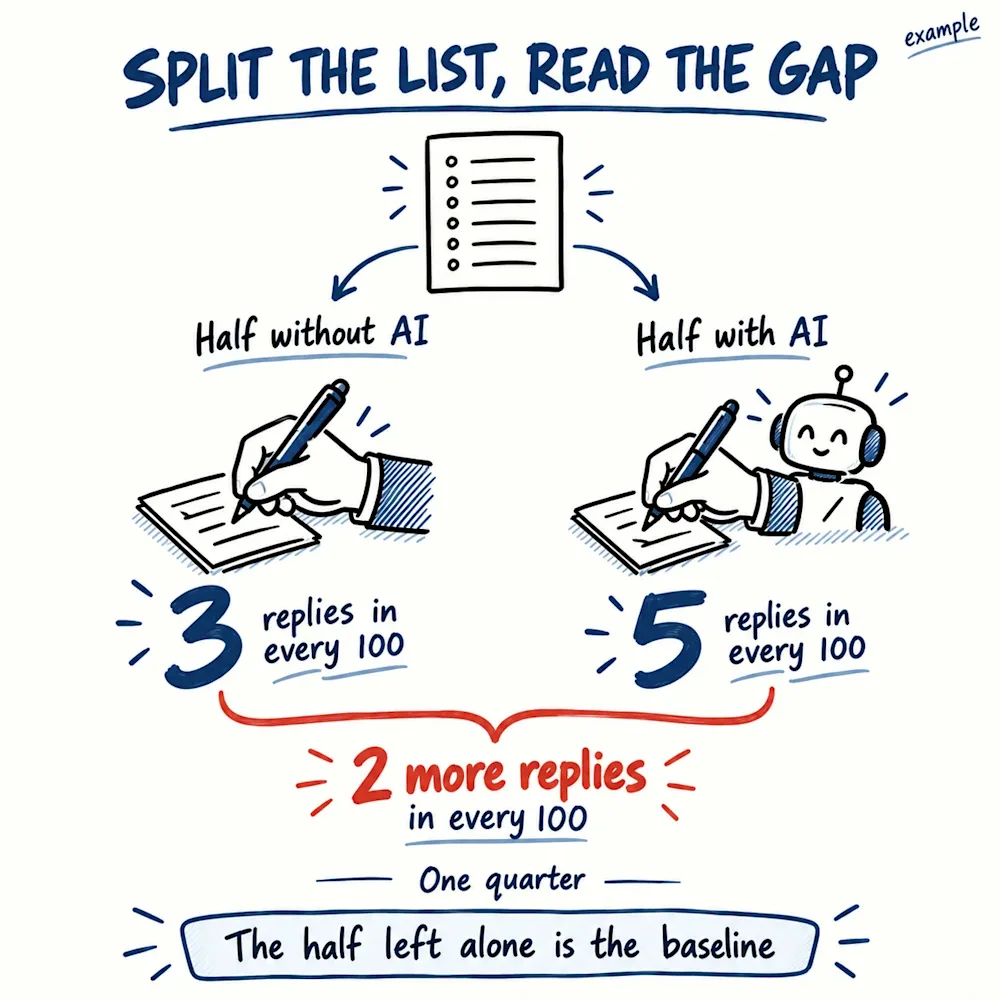
The baseline is the number you compare against. Write down today's number: how many in every 100 people you email reply, for example. Then split the list. Half gets the AI-written emails and half gets the old ones, for the same three months. From the day you split, the half left alone is your baseline.
To count it, turn the gap into clients, and the clients into money. Here is an example. The list has 1,000 customers, 500 in each half, for one quarter. The half without AI replies as before, 3 in every 100, so 15 replies; the half with AI replies 5 in every 100, so 25. The gap, 2 more replies in every 100, is 10 replies. This firm turns one reply in five into a paying client, so the 10 replies are 2 new clients, each worth €3,000 in the first year: €6,000. The AI cost €1,150 for the quarter, so the return is €4,850.
Check it after at least one sales cycle, the time your company takes to go from a first contact to a paid invoice. For most of the firms we work with, that is a quarter. Earlier than that, you are counting replies that are not money yet.
The trap is the season, or the market. Without the half left alone, the extra sales could be the season, the new website or a competitor closing down, and you will hear whichever story suits the person telling it. The list also has to be big enough. A gap of 2 in every 100 is worth trusting at about 1,500 emails in each half; with 500, as in the example, it can still be luck. On a smaller list, run the split again the next quarter, and count both quarters together before you trust the gap.
Route 3. A new business model
On this route the AI lets you sell a new service, a new product, or a new way of charging for what you know, and the return is the revenue from it.
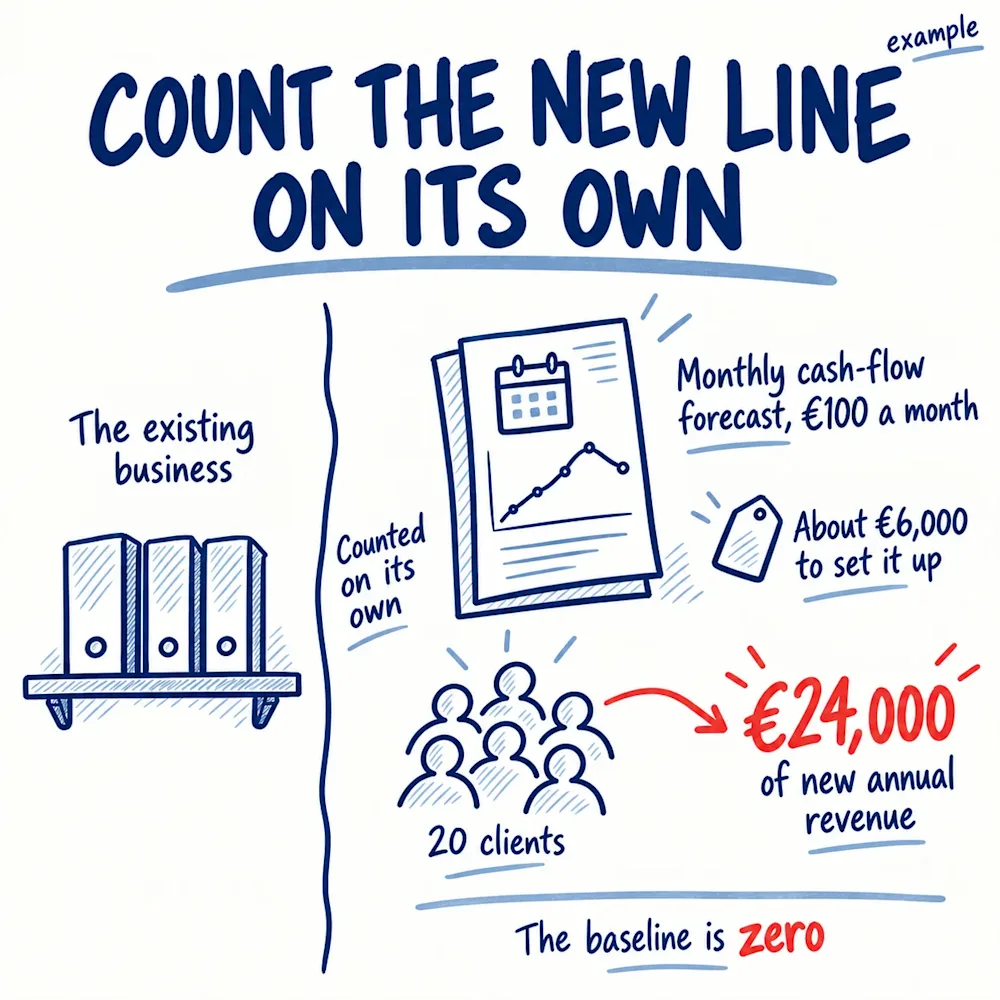
Before you start, write down two figures: the baseline, which here is zero, and what it costs to launch. Then give the new line a row of its own in your books from the first invoice, so its revenue never mixes with the rest of the business.
To count it, put the new line's revenue against what it cost to launch. Here is an example. A bookkeeping firm launches a cash-flow forecast for its clients, a view of the money coming in and going out over the next months, at €100 a month. It could not staff that service before AI. In year one 20 clients take it: €24,000 of new revenue, against about €6,000 to set it up.
Check it later than the other two routes, months to a year, because a new line has to find its buyers. The first check comes sooner, with the rule I give founders who want to build something new on AI: sell it to five clients first, and let their payments cover what it cost to build.
The trap is the new line lost inside the old business. In the firm's total revenue the €24,000 disappears into the bookkeeping fees. Add those 20 clients' bookkeeping fees to the new line, and it shows a return it never earned.
Bought on one route, counted on another
Here is an example. A firm buys an AI sales assistant for €2,000 to win clients, which is route 2. A year later the accountant counts the hours it saved, because that is the figure he has, and calls it paid back. Nobody asked about the two clients the owner believes it brought, or which hire was not made. Bought on route 2, counted on route 1, and the route 1 figure wins because it is the only one on the table.
The three-route card
So write the route down the day you buy. Copy this table.
Route | What you bought it for | What to write down first | How to count it | When to check | The trap |
|---|---|---|---|---|---|
1. cost cutting | Work you would otherwise hire a person for | Your hiring plan | The salary of the hire not made, less the AI cost | Month by month; the first months show a loss | Counting hours; €0 if you hire anyway |
2. more revenue from the same work | To sell more from the same work | Today's number, and half the list kept without AI | The gap between the halves, turned into clients and money | After one sales cycle, often a quarter | Crediting the AI for the season or the market |
3. a new business model | Something you could not sell before AI | Zero, and the launch cost | The new line's revenue against its launch cost | Months to a year; five paying clients first | The new line lost in total revenue |
Before you renew
This week, take every AI you pay for and fill in its row: what you bought it for, and the number from before. If your answer to "What you bought it for" is "I am not sure", settle that first, because until you do, any figure you put on the AI will be the hours.
What did you buy your AI for, and what are you counting?
The Clarity deep dive is free: 30 questions on money, customers, cash, growth, decisions and your market, about eight minutes, and you leave your email at the end and get the full report right away. When you want that answer tested against your own records, the Business Pulse diagnostic takes 30 days: you open your financials, sales records and contracts, sit in two meetings, and get a report with a prioritised action plan, every action with an owner and a timeline.