How Much of Your Sales Can AI Take Over? We Mapped Ours: 105 Activities, 4 Need a Person
Your sales take you and your people most of the day, and everybody says AI can do it now. We mapped our own sales on Upwork the way we would map a client's: 105 activities, all by hand. After four stages, map, automate, AI-sate and humanize, a person is needed at only four of them. Here is each stage, and how to start on your own process.
Your sales probably take you and two or three of your people most of the day. Someone looks for new leads, someone writes the offers, someone answers the messages and chases the ones that went quiet, and at the end you approve the price. Everybody tells you AI can do this now. Nobody tells you which part, or what stays with you.
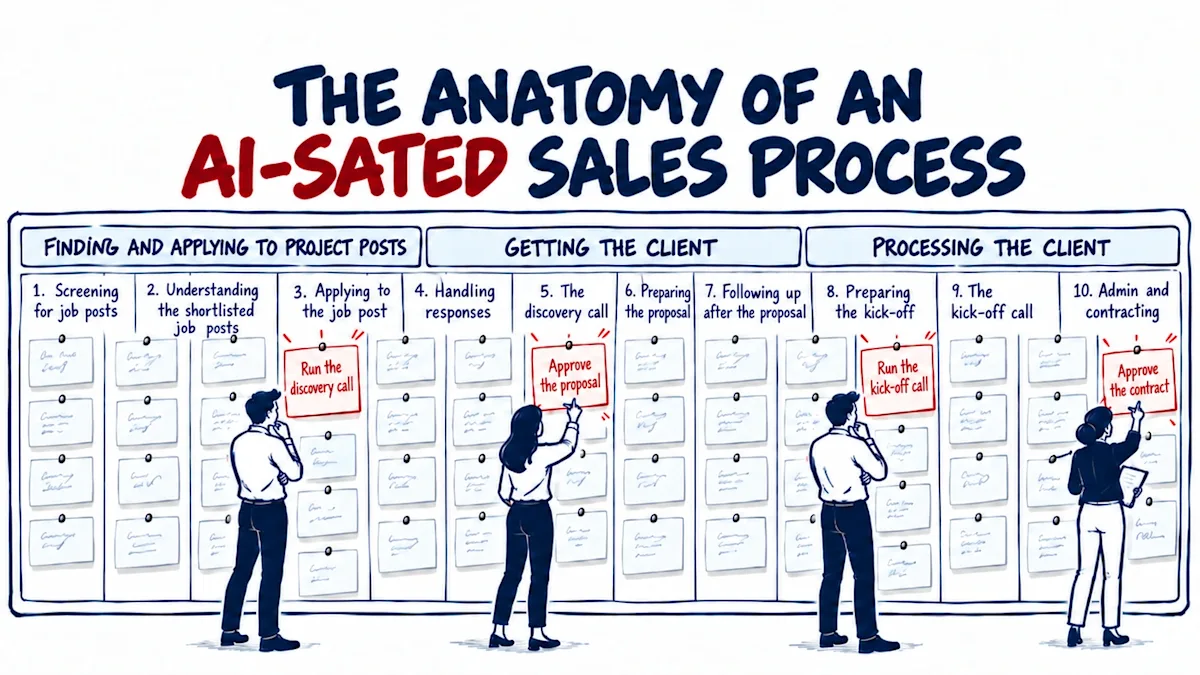
We had the same question about our own sales on Upwork, the marketplace where we find project posts and apply on them. So we mapped them the way we would map a client's. Written down the way the team really works, they came to 105 activities, all of them done by hand, from the first search to the signed contract. After automation and AI, a person is needed at only four of them: the discovery call, the approval of the proposal, the kick-off call and the approval of the contract. Code and AI carry the other 101, which is 96% of the process.
Before it was the company's, that process was mine. I started as a freelancer. At the end of 2014 I took my first client work on oDesk, the marketplace that later became Upwork, and for years I did everything there by hand: I searched for jobs, wrote the applications, answered the clients and closed the contracts. We still use Upwork as one of our sales channels, and after more than 360 jobs it is the process I know best.
We took it through four stages, always in the same order: MAP how the work really flows, AUTOMATE what goes the same way every time, AI-SATE what needs reading and writing, and HUMANIZE what is left for people. Each stage stands on the one before it, and skipping one collapses the next. Here is each one on our sales, and what it means for yours.
MAP: ten steps in three groups, all by hand
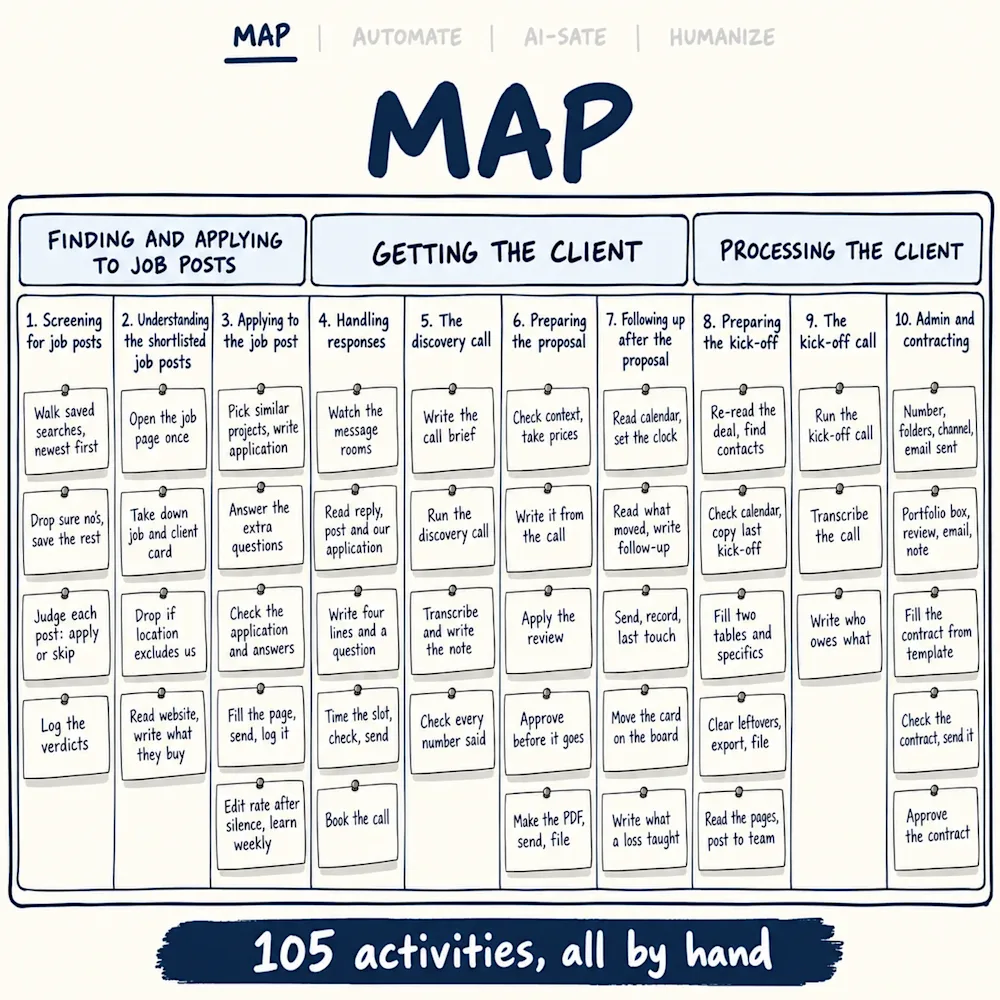
In your business, mapping means writing down how the work really gets done today, step by step, before anyone buys a tool or opens an AI chat. We did not do it from memory. We first had a few meetings with our sales team. We had an old document on how we run lead generation on Upwork, our playbook, and it had six or seven steps. But we wanted a fresh map, not the old document read back to us. Written down the way the team actually works, it came out at ten steps in three groups.
Finding and applying to job posts
- Step #1 Screening for job posts - every morning the team opens the saved searches, reads the new posts and decides which ones get an application. Upwork calls them job posts, but we apply on fixed-price projects too, so for us they are project posts. Most fall on the first read, on the rate, the country, or a project we already applied to.
- Step #2 Understanding the shortlisted job posts - the team reads each shortlisted post to the end, because the line that rules us out usually sits at the bottom. Then they look at the client, what they spent on Upwork, whom they hired, and their website. It ends on one sentence, what this client buys and what we would sell him, and the decision to apply or not.
- Step #3 Applying to the job post - the team picks two or three projects from our portfolio that are closest to this client and writes the application around them, with one question about their project. If the client added questions for every applicant, the team answers those too.
Getting the client
- Step #4 Handling responses - this step starts only when a prospect answers our application. When we see a response, someone from the team reviews it and responds.
- Step #5 The discovery call - someone from our team meets the prospect on a call. We ask what the project is before we pitch anything, and sometimes the posted project is not ours and the call finds the work that is.
- Step #6 Preparing the proposal - after the call, we prepare a proposal for the prospect with the scope, the timeline and the budget. We take a template that is partly written and finish it with the details for this prospect. Before it goes out, the person who signs for the company approves it.
- Step #7 Following up after the proposal - if the prospect goes quiet, we send a series of follow-ups to remind them and nudge them toward a decision.
Processing the client
- Step #8 Preparing the kick-off - once the prospect says yes, they are a client, and we prepare the kick-off document. It sums up what was discussed, the terms and the proposal, so we can get ready for the kick-off call.
- Step #9 The kick-off call - the client meets the team that will do the work, and together they settle the details.
- Step #10 Admin and contracting - we give the client a number, add them to our portfolio, update our other folders and prepare the contract, so the work can start.
Broken into what they really contain, the ten steps came out at 113 activities, and from here on we count activities, not hours, so a row in the tracker counts the same as a discovery call.
The fresh map paid off before a single line of code was written. The search page already shows the whole job post, so we can read the full list at once instead of opening every job one by one. We stopped paying extra to push our applications up the list. Eight of the 113 activities died on the table this way, and 105 is what we kept. The map also showed two things we had wrong: the saved searches were not sorted newest first, and many new clients every year never got a kick-off document.
AUTOMATE: what rules do before any AI
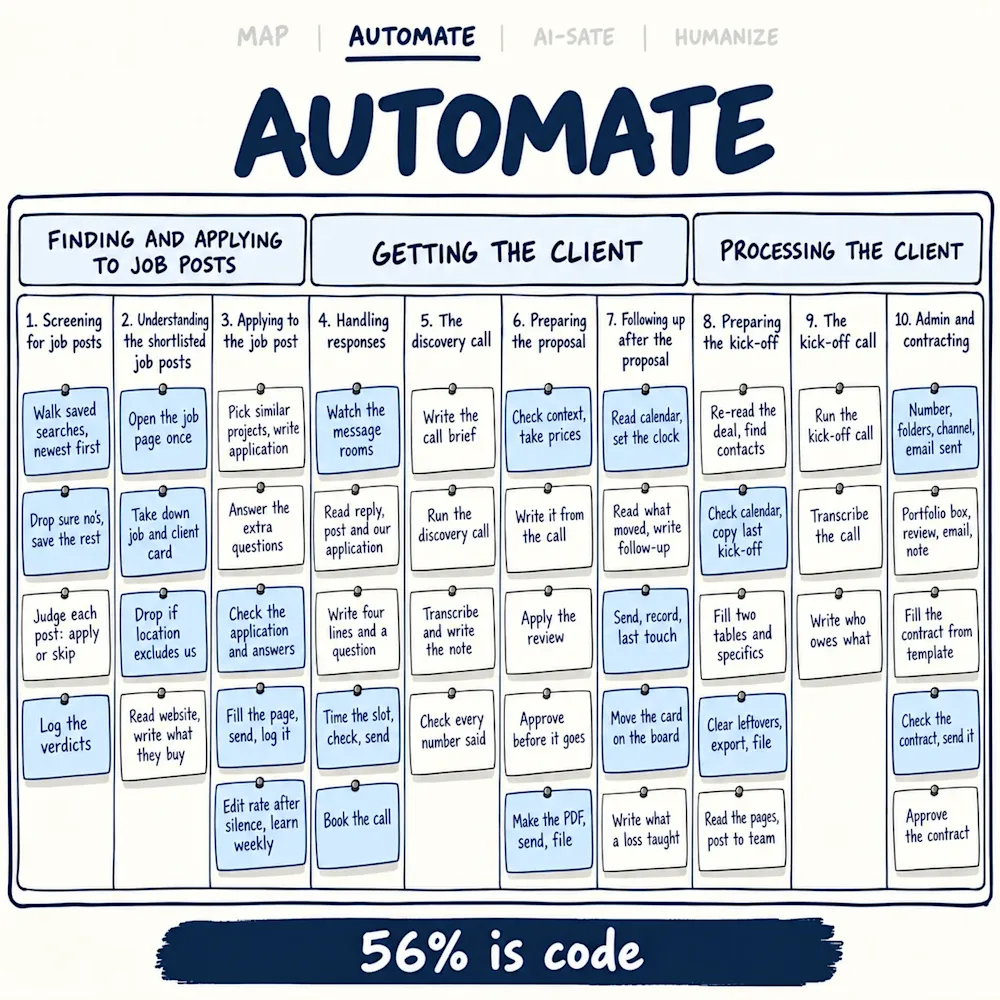
Here the repeat work in your business moves to rules, with no AI in it yet. With the map on the table, we put one question to every step: what here goes the same way every time?
Finding and applying to job posts
- Step 1 (Screening for job posts): code walks every saved search newest first, drops the sure no's by rule and saves the full text of the rest.
- Step 2 (Understanding the shortlisted job posts): code opens each surviving job page once, saves the job and the client card, and drops the post if the location line excludes us.
- Step 3 (Applying to the job post): code checks every application for the founding year and the banned words, skips a job whose answer boxes do not match the answers on file, fills the apply page, sends and logs it.
Getting the client
- Step 4 (Handling responses): code watches the message rooms, works out the call slot in the prospect's time zone, sends the reply once it is written and books the call.
- Step 5 (The discovery call): nothing to automate here, this is the call.
- Step 6 (Preparing the proposal): code checks the context before a word is written, takes every price from our offer card, and after the approval sends and files the proposal.
- Step 7 (Following up after the proposal): code reads the calendar first, so a booked call is never chased, keeps the clock on every quiet proposal and sends the follow-up.
Processing the client
- Step 8 (Preparing the kick-off): code copies the last kick-off, clears every trace of the previous client and exports the PDF.
- Step 9 (The kick-off call): nothing to automate here either, this is the call.
- Step 10 (Admin and contracting): code issues the client number, writes the database row, opens the folders and the shared channel, and checks the filled contract against our template, where only the company, the name and the amounts may change.
Everything the AI reads later is plain text on disk, saved there by these rules. Counted on the map, code carries 56% of the 105 activities, with no AI in any of it.
AI-SATE: where a model reads and writes
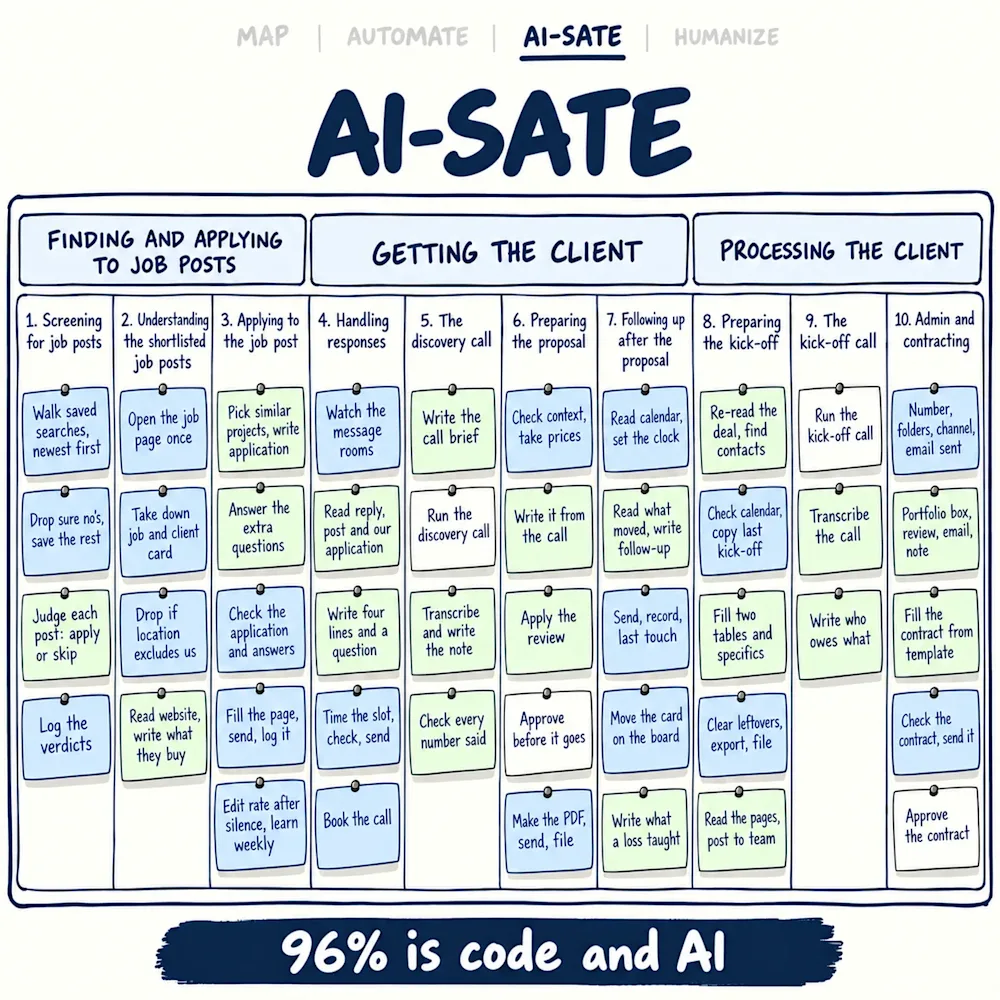
AI-SATE is a made-up word, and we use it because it says what the stage does: the way you automate with automation, you AI-sate with AI. For a business, it is the stage where AI takes the reading, judging and writing that a rule cannot do, on top of the code that already runs. Every AI helper reads files from disk and writes files back.
Finding and applying to job posts
- Step 1 (Screening for job posts): AI is the judge. Several AI helpers read the saved posts and write one verdict per post, apply or skip, and a second helper reads every skip again, blind.
- Step 2 (Understanding the shortlisted job posts): AI notes a few facts from the client's website and writes the sentence the team used to write by hand: what this client buys, and what we sell him.
- Step 3 (Applying to the job post): AI picks the projects from our portfolio, writes the application in the name on our profile and answers the client's extra questions, proof first.
Getting the client
- Step 4 (Handling responses): when a prospect answers, that conversation used to be ours. Today AI reads the message, the project post and our application and writes the reply, and code sends it. The conversation that stays ours is the call.
- Step 5 (The discovery call): AI prepares the notes for the call, and after the call writes the transcript and the note and checks every number said.
- Step 6 (Preparing the proposal): AI fills the context from the call, then writes the document and the message that carries the price, and applies the review.
- Step 7 (Following up after the proposal): AI reads what moved since the last touch and writes the follow-up, and for a lead we lose, what the answer taught us.
Processing the client
- Step 8 (Preparing the kick-off): AI re-reads the whole conversation, fills the kick-off document and reads the finished pages.
- Step 9 (The kick-off call): AI writes the transcript and the note.
- Step 10 (Admin and contracting): AI writes the box in our portfolio document, the won review and the email to the client, and fills the contract from our template.
Code and AI together now carry 96% of the map, and what is left sits in four places.
HUMANIZE: four touchpoints left
The last stage tells you what is still yours, after the map, the code and the AI. On the last walk through the ten steps we asked where a person still has to be, and the answer was four places: the discovery call, the approval of the proposal, the kick-off call and the approval of the contract.
Finding and applying to project posts needs no person at all. Automation and AI took it over completely, from screening the posts every morning to sending the application.
Getting the client needs a person in two places. The first is the discovery call: someone from our team runs it and finds out what the prospect really needs. Everything from there, the transcript, the proposal and the follow-ups, is AI and automation. The second touchpoint is the approval of the proposal, because a proposal is a commitment, so it goes out only after the person who signs for the company approves it.
Processing the client has two touchpoints as well. A person runs the kick-off call with the client and the team that will do the work, and a person approves the contract before the client sees it. Everything around them, the kick-off document, the client number, the folders and the filled contract, is prepared by code and AI.
That is 4% of the map. It is small in count, and every commitment the business makes sits in it.
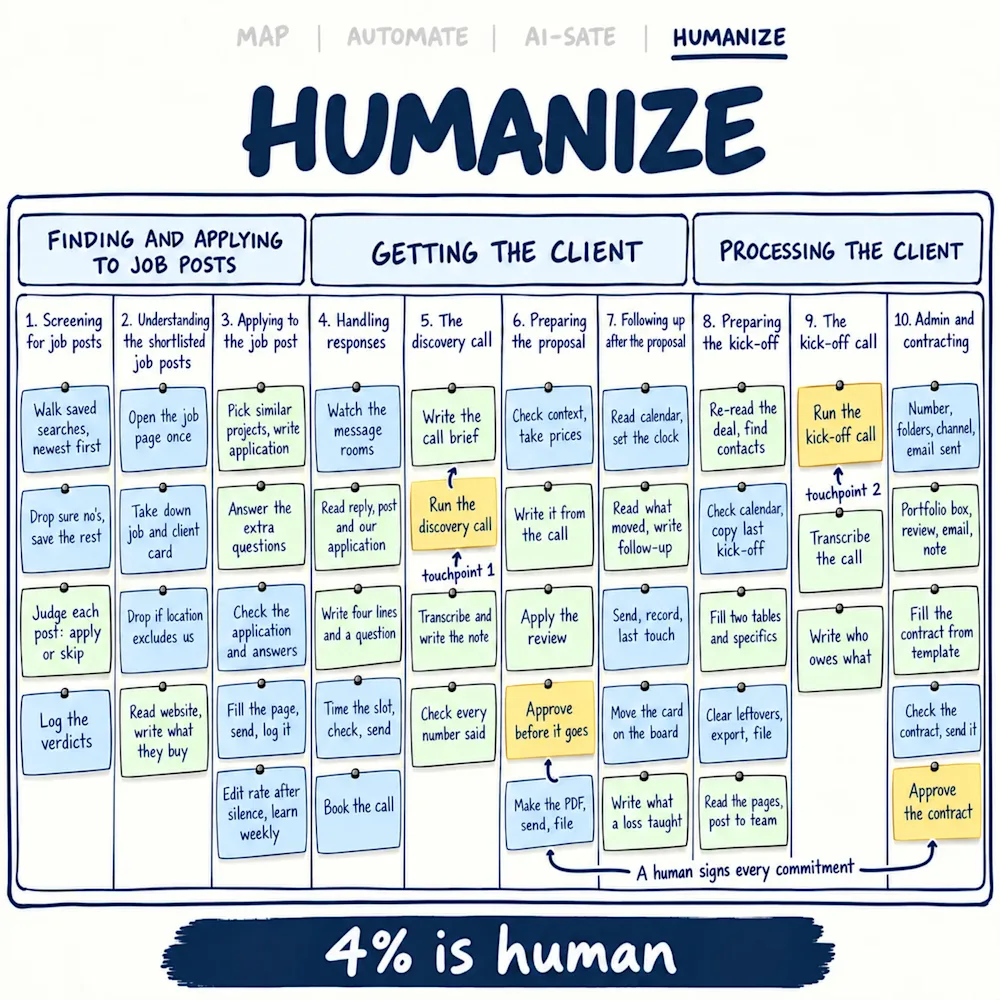
From 100% by hand to four touchpoints
Counted at the end, our sales map was 100% manual, code took 56% of it, code and AI together 96%, and 4% stayed with people. It only worked in this order. The map paid first, and none of what it found needed AI. The code went in before the AI, so the judge reads saved text instead of paying to open pages. And the human part came last, so we could see what was left instead of guessing it.
You can start on Monday, without buying anything. Take the process where the pain is loudest and write its steps down the way your team really works, not the way the old document says. Then break every step into what it really contains and count the activities, so a row in a spreadsheet counts the same as a call. Last, mark where a person must stay: the moments the business commits, a price or a signature, and the conversations where someone meets the client. In our sales there were four.
Automate the predictable, AI-sate the scalable, humanize the strategic.
Which process in your company would you map first, and how much of it do you think is still done by hand?
This is the Business AI work we do with owners. Every AI engagement starts with understanding your business, through Business Pulse, a 360-degree diagnostic delivered in 30 days, so we map how your team actually works before recommending any tool.