From your stated problem to a full diagnostic report: How a Business Pulse Diagnostic Works
You tell a consultant what is wrong, and the report that comes back could be about any company. Here is what a Business Pulse diagnostic does with your problem, step by step: what we ask of you, what we do with it, and what you hold at the end.
You know something in your company is not working. Revenue is down and you cannot say why, or the team is busy every day and the numbers stay where they were last year. Maybe your last consultant's report was long, correct, and could have been about any company in your street.
So before you give anyone a month and your files, you want to know what happens in that month. Here is what a Business Pulse diagnostic does with the problem you tell us about, step by step: what we ask of you, what we do with it, and what you hold afterwards, with one small company per step. Then you can judge it before you hire anyone, us included.
1. You tell us what is wrong
It starts with a conversation, with you and the people who make decisions with you. You do most of the talking. We ask what keeps you up at night, what you think holds the company back, and what you are about to spend money on.
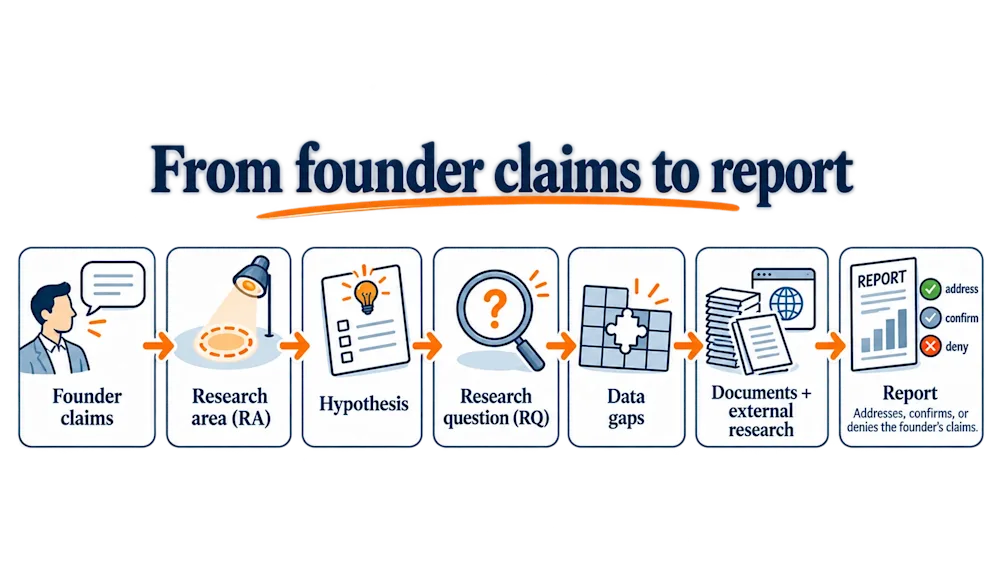
We write down what you say in your own words. "Sales are falling because the new competitor is cheaper" stays exactly that. Most owners bring one to four statements like it, and each becomes a claim we test and answer in the report. The founder of an app studio of about twenty people taught us why that matters. He came with one question: was one new fixed-price offer the right next step? Our report went through every department we knew. He read it and told us he knew all of it already, and he was right. That sentence is why the first meeting belongs to you.
You leave it with your problems written down in your words, as the list the report has to answer.
2. We find where the answer lives in your company
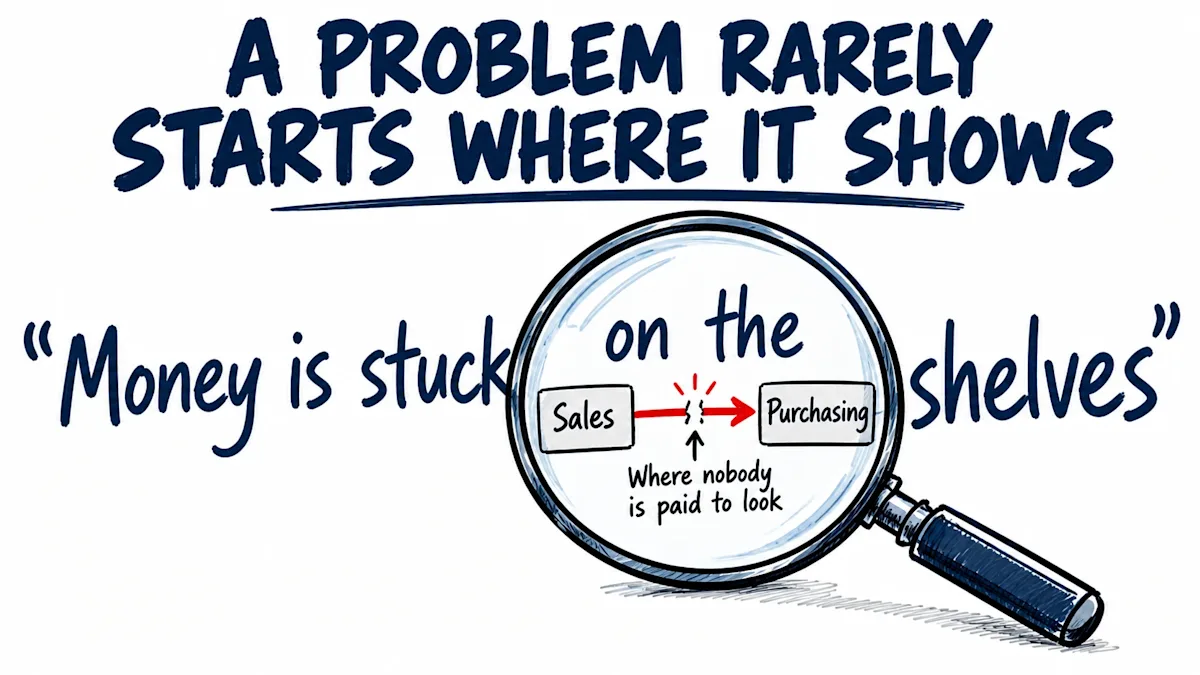
After the meeting we take each statement and name the part of the business it belongs to. "We are getting fewer customers" points to sales. "Money is stuck on the shelves" points to stock and purchasing. That gives two to five areas to research. Then we ask what decides the thing you are worried about: a price is set by what the product costs you, what competitors charge and what customers will pay, so checking only your costs misses two thirds of the answer. And we follow each area across your departments, because a problem rarely starts where it shows. The cost sits between departments, where nobody is paid to look.
One owner of an LED and electrical distributor guessed his unsold stock at anywhere between a fifth and a half of his shelves. When we counted, a bit more than a fifth had not sold for a year or longer, so his guess held. Where it came from, nobody in the building could see: purchasing ordered what the supplier had on offer, and sales never told purchasing what clients kept asking for. That same way of buying also left four in ten products with buyers and nothing in stock.
3. We turn your belief into something your numbers can answer
For each area we write one hypothesis: a statement of what might be causing the problem, written so your own records can prove or disprove it. Before we open a file, we write beside it what would confirm it and what would deny it, so the answer comes from what we find, not from what anyone hoped. We keep the statement broad on purpose: if every check inside sales comes back clean, we tell you the problem is not in sales, and show you where it is.
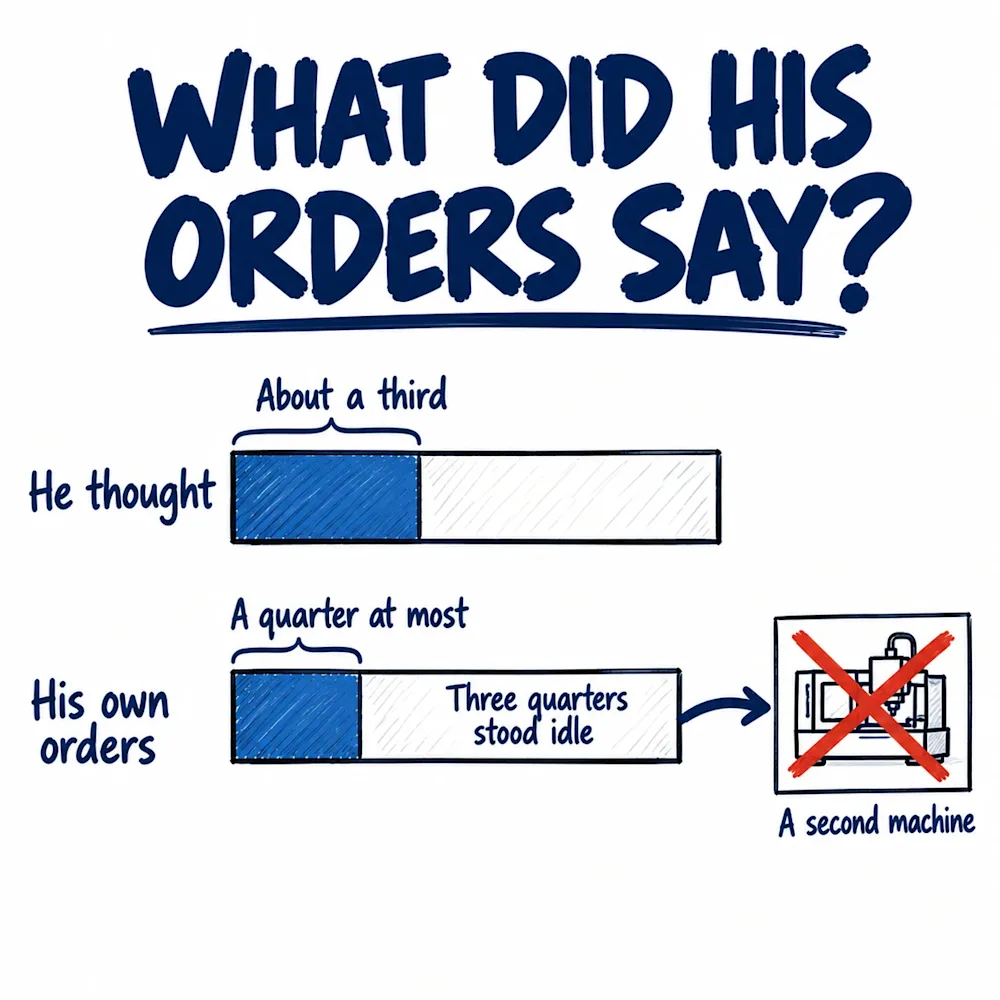
Take a joinery maker, PVC and aluminium windows and doors, about ten people. Glass felt like what held the workshop back, so he planned a new glass-cutting machine. We wrote his plan as a statement his records could answer: a new machine will give the workshop capacity it does not have today. By his own estimate the machine he had was busy about a third of the time. What his orders said is in step 7.
4. We decide what we need to find out
A hypothesis says what might be true. The research questions say what we have to find out to know whether it is: if the statement were true, what would we see in the numbers, and what if it were false? Each is answered from your records, from our research outside the company, or both. Before we ask for a file, we show you the questions, and you cross out what does not matter and add what we missed.
One owner saw his growth slow after a cheaper competitor came into his market, and asked whether the competitor was the reason. That was two questions: what had happened to his own clients, which his records could answer, and what the competitor charged, which sat outside his company. His records answered first: two in five of his clients never came back. He had sent us to the competitor. The answer was in his own invoices.
5. We list what we need from you
Every research question needs something: a sales export, a stock list, payroll, or an hour with you. You get one list of what we need, each item tied to its question. You send what you have, within the first five working days. Where your numbers sit in a delivery app or a till system, you give us access and we pull the reports ourselves. You are asked once, for specific things, and your evenings stay yours.
Three partners run a bistro selling at the counter, through two delivery apps and catering. The partner who keeps the numbers was open with us and called his own Excel broken. Our AI opened the delivery apps and the till software and pulled the reports. Their part was the access and a few questions. They now hold one set of numbers, from the till and both apps, the same each time we run the files.
6. We read your files and look outside the company
We read every file you give us, in full. We write down only what serves one of your questions. Some of what we asked for never arrives, because it does not exist, and that is an answer in itself.
Then we look outside the company, at what your competitors charge and publish, with a phone call or a mystery purchase when needed. Your files tell us what happened inside the company; only the market can tell us whether it happened to you or to everyone.
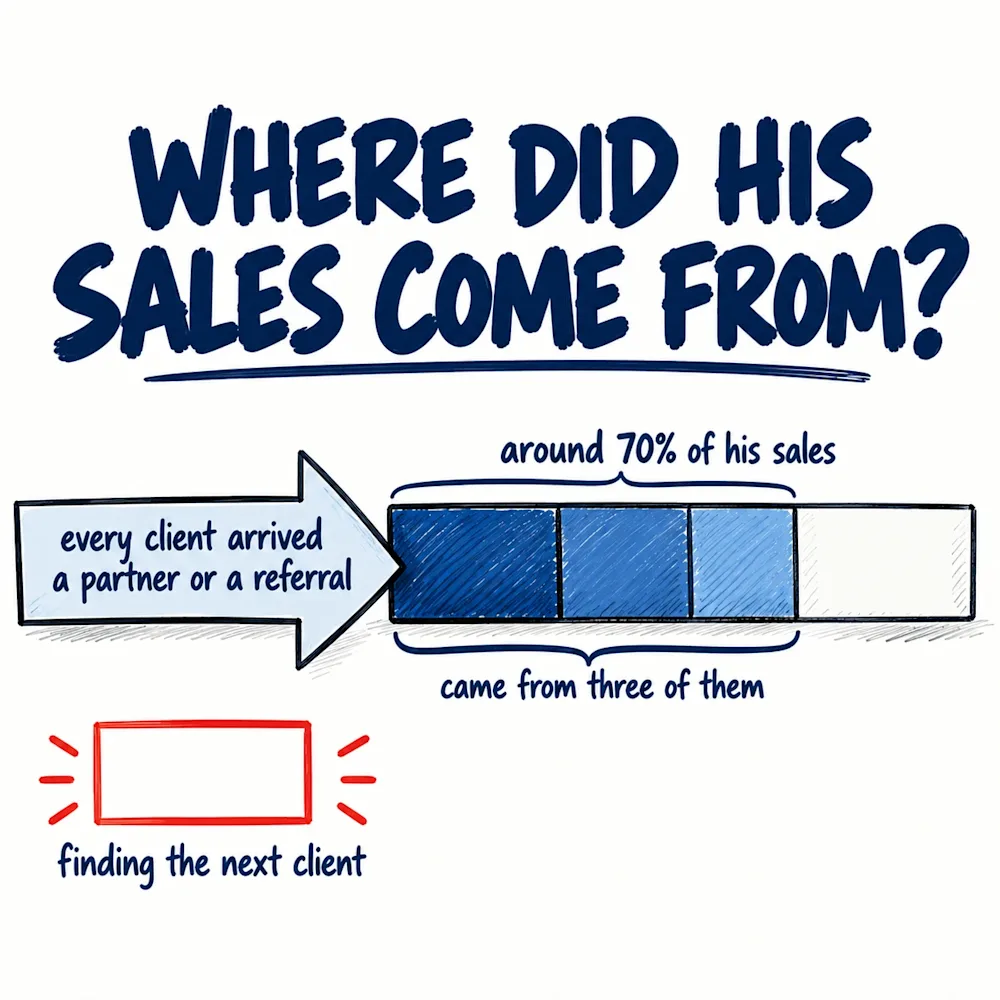
The app studio from step 1 sold development work to other companies, and every client arrived through a partner or a referral. When we asked for the sales figures split by type of client, there were none. That gap was an answer on its own: nobody in the studio had the job of finding the next client, and around 70% of his sales came from three of them.
7. The report answers you, claim by claim
The report goes back to what you told us in the first meeting and answers each claim: confirmed, denied, or a different problem from the one you named, with the reason underneath it, which is often not in the department where it hurt. "It is not this" closes a question too: a table showing you are already the cheapest in your market ends the talk about price. Every line points to the document it came from.
In the third week we sit down with you and go through what we found. You challenge it, and we adjust. Then we build the action plan with you: what to stabilise in the first six months, what to build in the twelve after that, and where to aim after eighteen. Report and plan reach you in the fourth week, before the money is spent.
Back to the joinery maker from step 3. He thought his machine was busy about a third of the time. More than five hundred of his own orders said a quarter at most. Three quarters of the capacity he already had stood idle, so a second machine would have too, and he let his own numbers have the last word on his own plan.
You finish with an answer to each thing you told us, the evidence beside it, and a plan you helped build.
How all of this fits in 30 days
It fits in 30 days because the reading is not done by hand. Our AI reads every file you give us, in full, and counts what it finds. One owner gave us 84 files, another 580, each one read the same way. It also drafts: the tables, the first wording of each answer, and the report you hold at the end.

AI reads, counts and drafts. The consultant writes the questions, and decides. If we miss the questions, we miss the data, and the report answers something you never asked. When two of your files disagree, we read the contradiction and bring it to you.
What we need from you in that month is in the next section. Because the same files give the same numbers every time we run them, a figure in your report is the figure a second run gives, the one you put in front of your partner or your bank.
Your part of the month
Four weeks, and most of them are ours. Yours are the first meeting, the files you already have within five working days, one contact person for our questions along the way, and the meeting in the third week. The report and the plan are yours: carry them out yourself, with us, or with someone else.
One question, this time about you
What are you about to spend money on because it feels right? Pull last year's orders or sales and count whether the records say what you believe. If they do not, you have just done in one evening what the joinery maker's five hundred orders did for him, and it needed nobody from outside.
The Clarity deep dive asks 30 questions and shows you where you're guessing, where you're blind, and what to check first. When you want what you believe tested against your own records, that is what the Business Pulse diagnostic does, in 30 days.