COO vs Fractional COO vs Consultant: Which One Does Your SME Actually Need?
The three roles sound similar. They're radically different. Full-time COO, fractional COO, or consultant - a decision framework with costs, when each wins, and how to avoid the €50K mis-hire most SMEs make.
Every six months a founder emails me some variant of: "I think I need a COO. But maybe a fractional? Or should I just hire a consultant for three months? What's actually different?"
The three options sound similar. They are radically different roles. Picking the wrong one wastes somewhere between €20K and €150K and six to twelve months of momentum. Worse, the failure looks like it was caused by the person you hired - so you blame them, try the next flavour, and waste another year.
This guide separates the three cleanly and ends with a decision framework you can apply in an afternoon.
What each one actually is
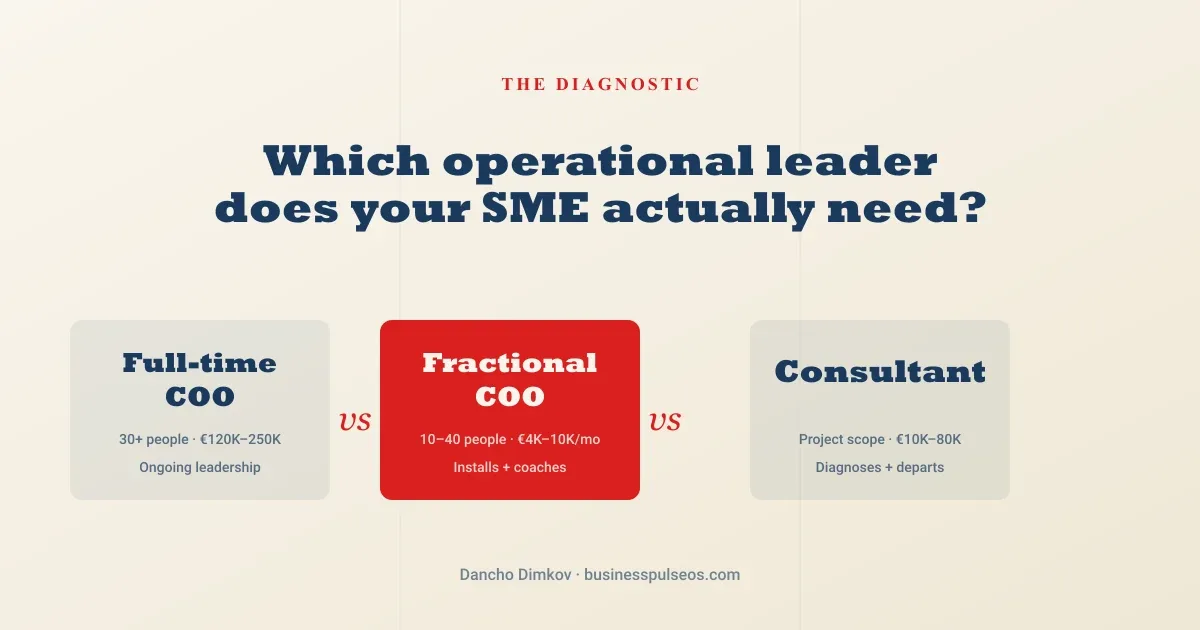
Full-time COO. A senior executive who holds a line role on your team. Reports to you. Owns operations, delivery, sometimes finance. Attends every leadership meeting. Makes decisions in your absence. Is accountable for operational P&L. Typical cost: €120K-€250K fully loaded, depending on market and seniority.
Fractional COO. A senior operator who works 1-2 days per week for your company, usually on a 6-18 month engagement. Installs systems, runs leadership rhythms, coaches your team. Makes decisions within defined scope but doesn't replace an internal operations leader long-term. Typical cost: €4K-€10K/month.
Consultant. An external advisor with a defined project scope and end date. Diagnoses, recommends, often implements alongside your team. Doesn't hold a role, doesn't replace leadership, doesn't own outcomes past project end. Typical cost: €10K-€80K for a project.
The difference in one sentence: a consultant diagnoses and departs, a fractional COO installs and coaches, a full-time COO runs.
When each one is the right answer
Full-time COO is right when:
- You're 30+ people and operations is complex enough that it needs daily ownership.
- Your leadership team already has obvious gaps that a full-time hire fills.
- You have €150K+/year budget for the role plus 12+ months runway to see the investment pay off.
- You can clearly describe the first 90 days of what they'd do.
Full-time COO is wrong when: you're under 20 people, when you don't have a structured role for them to step into, or when you're hiring one to compensate for you not wanting to do operations (that problem isn't fixed by hiring over it).
Fractional COO is right when:
- You're 10-40 people and growing.
- You need operational structure installed and ongoing leadership, not just a plan.
- You don't have the budget or the scope to justify a full-time hire.
- You need the senior pattern-recognition of someone who's seen many SMEs, which a single internal hire can't match.
Fractional COO is wrong when: the project has a clear end date (use a consultant), when the company is large enough to need full-time ownership (hire properly), or when there's no one internally to hand the work to after the fractional leaves.
Consultant is right when:
- You have a defined problem with a defined end (go-to-market strategy, diagnostic, org redesign, system implementation).
- You need specialised expertise you don't need permanently.
- You want someone to challenge thinking and deliver a specific output.
- You have an internal team that can own the implementation afterwards.
Consultant is wrong when: you need ongoing leadership (they won't provide it), when you don't know what the problem is yet (you want a diagnostic first, not a solution consultant), or when your internal team can't absorb the work after the consultant leaves.
The cost-over-time comparison
Here's what €60K in one of these roles buys you:
- Full-time COO at €120K/year: six months of a full-time senior executive.
- Fractional COO at €7K/month: ~8.5 months of 1-2 days per week.
- Consultant at €60K project fee: one complete engagement, typically 3-4 months of effort.
The comparison isn't which is cheapest per hour. It's which gives you the outcome you need in the timeframe you need it, given your stage.
An SME with €60K to spend is almost always best served by either fractional COO (if ongoing leadership is the need) or consultant (if a project is the need). Full-time COO for six months is the worst option - you can't install them properly, you can't judge them fairly, and they'll leave before you see compounding returns.
Four questions to pick the right one
Question 1: Do you have a defined project with an end date, or an ongoing gap?
- Defined project with end → consultant
- Ongoing gap → fractional or full-time COO
Question 2: What's your company size?
- Under 20 people → consultant or fractional (full-time is too heavy)
- 20-40 people → fractional (sweet spot)
- 40+ people → full-time COO if you have the budget, fractional if you don't yet
Question 3: Do you know what the real problem is?
- Yes, clearly → consultant or fractional can execute against it
- No, not really → run a diagnostic first; don't hire anyone until you know what you're hiring them to do
Question 4: How much senior operator time do you actually need?
- 40+ hours/week → full-time COO
- 10-20 hours/week → fractional
- One-off project → consultant
Write down your answers. The matrix above resolves to exactly one of the three options in most cases.
The most common mistake
Founders hire consultants when they need fractionals, and fractionals when they need consultants.
The consultant pattern that fails: you hire a consultant for "operations help," they run a 3-month engagement, produce a plan, leave, and you implement 20% because you're too busy. The root mistake was hiring a consultant when you needed ongoing operational leadership.
The fractional pattern that fails: you hire a fractional for a specific 90-day installation, they turn it into an 18-month retainer, the scope drifts, and you're paying €7K/month for advisory calls. The root mistake was hiring a fractional when you needed a consultant.
The fix for both: name the end state clearly before you hire. If the end state is "a strategy document we implement internally" → consultant. If the end state is "a structured operations function with a team member running it" → fractional. If the end state is "a permanent member of leadership" → full-time.
What to do next
- Do the four-question exercise this week. Write your answers. The answer will be clearer than you expect.
- Talk to three candidates for the role you identified. Ask them the five questions from our consultant-selection guide. Their answers will filter fast.
- Run a diagnostic first. If you're not sure what role you need, the Business Pulse diagnostic usually surfaces the answer as a by-product. €3,000 to save the €50,000 you'd waste on the wrong hire.