BusinessPulse OS vs EOS vs Scaling Up - Which One Should an SME Actually Use? (2026)
Honest comparison of the three operating systems most often considered by SMEs in 2026. Side-by-side table, deep dives, and a four-question decision framework.
If you're a small or medium enterprise (SME) founder who has typed "alternative to EOS" or "is Scaling Up worth it" into a search engine recently, you're in the same place hundreds of other founders are: convinced your company needs more structure, suspicious that the popular options weren't built for your situation, and tired of generic advice that says "just pick one and run with it."
This guide compares the three operating systems most often considered by SMEs in 2026: EOS (the Entrepreneurial Operating System), Scaling Up (Verne Harnish's framework), and BusinessPulse OS. The goal isn't to crown a winner - it's to help you figure out which one actually fits your company.
We'll cover what each one is, what each one does well, where each one falls short, and a four-question decision framework at the end.
Why this comparison matters in 2026
The three frameworks were built in very different eras for very different problems.
EOS was created by Gino Wickman and codified in Traction in 2007 - a year before the global financial crisis, before the smartphone reshaped how teams communicate, before remote work, before AI tooling. It was designed for traditional 20-250 person American companies operating in a stable office-based environment.
Scaling Up emerged from Verne Harnish's Mastering the Rockefeller Habits (2002) and was substantially updated as Scaling Up in 2014. It's more sophisticated than EOS, financially rigorous, and explicitly aimed at companies past the $5M revenue mark.
BusinessPulse OS is newer - built specifically for the post-2020 SME landscape: hybrid teams, AI-native operations, lean budgets, and a customer base that doesn't tolerate the old "framework rollout" timeline. It was designed in Europe, for European SMEs, by consultants who'd run hundreds of B2B engagements and noticed that most off-the-shelf frameworks asked the company to fit the framework, rather than the other way around.
That difference in origin matters more than the marketing pages suggest. A framework built for a 150-person American manufacturer in 2007 will work imperfectly for a 25-person European SaaS company in 2026. Sometimes that imperfection is fine. Sometimes it's expensive.
Side-by-side comparison
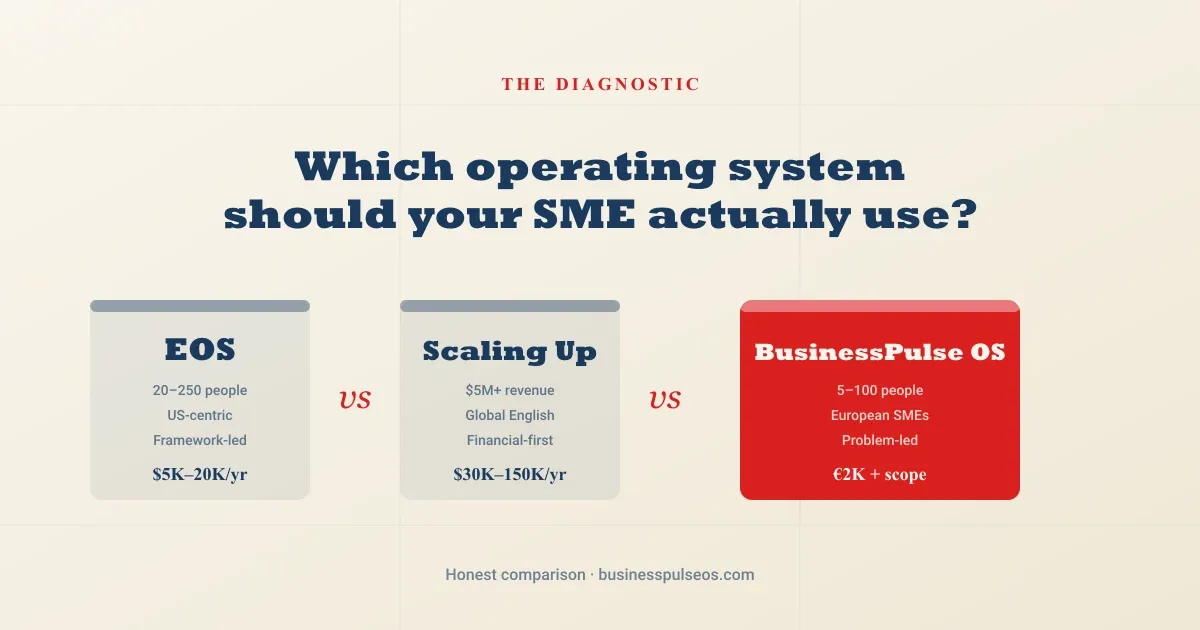
EOS Scaling Up BusinessPulse OS Origin Gino Wickman, Traction (2007) Verne Harnish, 2002 → 2014 BizzBee Solutions, 2024-2025 Best for size 20-250 employees $5M-$500M revenue 5-100 employees Geography US, UK, Australia US, global English Europe, Balkans, EU Time to first results 90 days for L10 cadence 3-6 months for OPSP 30-day diagnostic Cost (typical) $5K-$20K/year $30K-$150K/year €3K diagnostic + scope Approach Framework-led Framework-led Problem-led Built-in AI guidance Limited Limited Yes (4-step methodology) Strongest where Repeatable installs Financial discipline Diagnosing real problem
Deep dive: EOS (Entrepreneurial Operating System)
EOS is the most popular operating system for SMEs in the United States. It's defined by six components - Vision, People, Data, Issues, Process, and Traction - and three core tools: the VTO (Vision/Traction Organizer), the L10 meeting (a 90-minute weekly leadership meeting with a fixed agenda), and Rocks (90-day priorities).
Where EOS shines
The genius of EOS is its simplicity. You can read Traction in a weekend and understand the entire system. The VTO fits on two pages. The L10 has a fixed agenda that anyone can run. There's a vast network of EOS Implementers (over 700 worldwide as of 2025) who can install it in a predictable way.
For a 50-person company that's never had any structure, dropping in EOS is like dropping in a pre-built kitchen. It works. The team gets a common vocabulary. Meetings get shorter. Priorities get clearer. There's a reason 200,000+ companies use it.
Where EOS falls down
EOS asks your business to fit its mould. Companies that don't have a traditional org chart, that operate across borders, that are mostly remote, that are heavily project-based (agencies, consultancies), or that have unusual industry dynamics often find themselves hammering square pegs into round holes.
The L10 meeting agenda - Segue, Scorecard, Rock Review, Customer/Employee Headlines, To-Do List, IDS - is rigid. The VTO format is rigid. The "Issues List" approach assumes a linear problem-solving rhythm that doesn't always match how strategic work actually happens.
EOS is also distinctly American in tone and assumption. The terminology, the case studies, the cultural defaults all assume a US business context. For European SMEs, especially in non-English-first markets, the translation cost is real.
Best fit: US-based companies, 20-250 people, in industries with predictable rhythms (services, distribution, manufacturing, established SaaS) where the founder wants a battle-tested framework with a strong coach network.
Bad fit: Companies under 20 people (overhead too high), heavily creative or research-driven companies, companies whose biggest problem is something the framework doesn't address (e.g., unclear product-market fit, broken go-to-market motion).
Deep dive: Scaling Up
Scaling Up is the more sophisticated cousin of EOS. Where EOS focuses on six components, Scaling Up focuses on four decisions - People, Strategy, Execution, Cash - and uses a one-page strategic plan called the OPSP as its central tool.
It draws heavily from John Kotter's change management work, Jim Collins's good-to-great research, and Verne Harnish's own decades of running CEO peer groups (the YPO and EO networks).
Where Scaling Up shines
Scaling Up is, frankly, a better-engineered framework than EOS for companies past the $5M revenue mark. The financial discipline alone is worth the investment: cash conversion cycle analysis, the Power of One exercises, monthly financial rhythm. If you're a growing company that's about to hire executive leadership, raise capital, or expand into new markets, Scaling Up gives you the language and the structure to do it well.
The certified coach network is smaller than EOS but generally more experienced - Scaling Up coaches tend to be former executives, not just framework-trained facilitators. The annual Scaling Up Summit in the US has become one of the most respected SME-leadership events in the world.
Where Scaling Up falls down
Scaling Up is heavy. The OPSP looks deceptively simple but takes months to fill out properly. The framework assumes you'll spend significant executive time on Scaling Up itself - quarterly off-sites, monthly cash meetings, annual planning. For a sub-$5M company, this overhead is prohibitive.
It also assumes you have a leadership team to scale with. If you're a founder running a 15-person company where you're still the head of sales, the head of product, and the head of operations, Scaling Up's executive-team rituals don't yet apply to you. You have to install the executive team first, which is its own multi-year project.
Like EOS, Scaling Up is framework-led. It tells you what to install. It's less helpful at diagnosing whether you should install it at all, or which parts you actually need.
Best fit: $5M+ revenue companies with a real executive team, planning to grow 2-10x in the next 3-5 years, with the appetite to invest €30K-€150K/year in coaching and tooling.
Bad fit: Companies under $2M in revenue, founder-led companies without an executive layer, companies that need an outside party to find their problem before solving it.
Deep dive: BusinessPulse OS
BusinessPulse OS is the newest of the three. It was productised by Dancho Dimkov and the BizzBee Solutions team after running hundreds of B2B engagements across Europe and the Balkans. The core insight that shaped it: most SMEs that buy a framework do so before they actually understand what their problem is - and end up paying to install structure that doesn't fit.
So BusinessPulse OS inverts the order. It begins with Business Pulse, a 30-day diagnostic that maps your business across four modules: Pulse (diagnose), Build (structure), Growth (scale), and AI (accelerate). Only after the diagnostic produces a prioritised action plan does the framework prescribe what to build.
Where BusinessPulse OS shines
The diagnostic-first approach is the system's real differentiator. In every diagnostic completed so far, the founder's initial description of the problem turned out to be partially correct but missed the cross-departmental root cause. That's a documented pattern, not a marketing claim. Founders inside the business genuinely cannot see what's invisible to them. An external diagnostic catches it.
The system is also AI-native - not as a buzzword, but structurally. The AI module isn't bolted on as an afterthought; it's one of four foundational components, with an explicit methodology (Map → Automate → AI-ify → Humanize) that ensures AI implementation actually fits the business rather than being shoehorned in.
For European SMEs especially, the cultural and economic context fits better than the US-origin frameworks. Pricing is calibrated for European SME budgets. The methodology accommodates lean teams, hybrid work, and the messier-than-American operational realities most EU founders face.
Where BusinessPulse OS falls down
It's newer. There isn't a 700-coach implementation network. There isn't a 200,000-company case study library. There isn't an annual summit you can fly to. If you want a system with massive social proof, EOS wins on that dimension and it's not close.
The diagnostic-first model also requires founder commitment that some don't want. If you already know your problem and just want execution help, the 30-day diagnostic feels like a delay. (For some companies, it's also genuinely unnecessary - a fractional COO might be the right answer instead.)
And because every engagement is custom, you can't read a book and DIY BusinessPulse OS the way you can with EOS. The engagement model is high-touch. That's good for fit; it's bad for scale.
Best fit: European SMEs of 5-100 people, especially those that have tried a framework before and felt it didn't fit, or those who suspect their real problem isn't the one they're trying to solve.
Bad fit: Companies that already have a clear, well-defined problem and just want execution help; companies that need an enormous coach network for social proof; companies fully committed to either EOS or Scaling Up that just want optimisation within those frameworks.
A four-question decision framework
If you're reading this comparison hoping it'll tell you which one to pick, here's the honest answer: it depends on four things. Walk through these in order.
Question 1: How big is your company?
- Under 10 people: Don't use any of these yet. You're too small. Build basic discipline first - documented processes, weekly metrics, clear roles. Revisit in 12-18 months.
- 10-50 people: All three are viable. BusinessPulse OS is generally the best fit because the others are designed for larger companies and the overhead can be prohibitive at this stage.
- 50-250 people: EOS or BusinessPulse OS depending on geography and complexity. Scaling Up if you're past $5M revenue and have a real executive team.
- 250+ people: Scaling Up is built for you. EOS will feel constraining at this size.
Question 2: Do you actually know what your problem is?
If you can finish this sentence with confidence - "My company's biggest problem right now is X, and I need help with the execution" - then a framework-led system (EOS or Scaling Up) gives you the structure to execute.
If you genuinely don't know, or you've been wrong about it before, or you have multiple competing theories about what's broken - then a problem-led system (BusinessPulse OS) is the better starting point. The diagnostic will tell you what to fix first.
Question 3: Where do you operate, and what's your team's first language?
EOS and Scaling Up are American. The terminology, case studies, cultural assumptions, and most of the content are US-centric. They translate, but the translation has friction.
If you're in the US, UK, Canada, or Australia, that friction is minimal. If you're in continental Europe, the Balkans, the Middle East, or anywhere where English isn't the native business language, BusinessPulse OS will feel natively designed for your context. EOS will feel imported.
Question 4: What's your appetite for commitment and cost?
- Low budget, want to try DIY: Read Traction and try EOS yourself. It's the cheapest path because the book ($25) plus a 90-day pilot of the L10 meeting can get you most of the value.
- Medium budget, want guided installation: EOS Implementer ($5K-$20K/year) or BusinessPulse OS diagnostic + scoped implementation (€3K diagnostic + project-based fees).
- Large budget, serious about long-term partnership: Scaling Up coach engagement ($30K-$150K/year) or BusinessPulse OS as ongoing strategic partner.
Common scenarios
"We're a 25-person EU-based agency. We tried EOS and it felt like wearing someone else's suit." You're not alone. Service businesses with project-based work often struggle with EOS's rigid agenda and metric structure. Consider BusinessPulse OS, which accommodates project-based businesses more naturally.
"We're a 12-person SaaS startup with 10x growth ahead. What's the right system?" Probably none of these yet. Your real problem at that size is usually product-market fit and go-to-market motion, not operational structure. Get the basics in place yourself (weekly metrics, decision rights, simple process docs), and revisit at 25-30 people.
"We're a 75-person manufacturer in Ohio that did $14M last year and we're growing 30%." You're in the EOS or Scaling Up zone. EOS if you want simplicity and you're allergic to overhead; Scaling Up if you want financial rigour and you have an executive team to scale.
"We're a 40-person consultancy in Skopje and our biggest problem is that we don't know what our biggest problem is." This is exactly what BusinessPulse OS was built for. Run the diagnostic first.
What about other systems we didn't cover?
A few honest mentions:
- Holacracy / Sociocracy: Designed for radical decentralisation. Powerful in the right culture, disastrous in the wrong one.
- OKRs (Objectives and Key Results): Not a full operating system - it's a goal-setting framework. Pairs well with any of the three above.
- The Great Game of Business: Open-book management approach. Strong for companies where financial transparency unlocks employee engagement.
- Fractional COO without a framework: Genuinely a strong option that competes with all three. An experienced operator working 1-2 days a week can install enough structure to get you through the next 18-24 months without committing to any specific system.
How to decide this week
- Score yourself against the four questions above. Write the answers down. Be honest, especially about Question 2.
- Read the relevant book. Traction if you're leaning EOS; Scaling Up if you're leaning Scaling Up. For BusinessPulse OS, read the diagnostic page and the About page.
- Talk to someone who has run an engagement. Not a salesperson - someone who has actually been a customer for 12+ months. Ask them what they wish they'd known.
- Pilot before you commit. No matter which one you choose, run a 90-day pilot with a small piece of the system before you sign a year-long commitment.
The worst mistake at this stage isn't picking the wrong system. It's picking no system, staying stuck in founder-as-bottleneck mode for another year, and revisiting the same question in 2027 with another 12 months of accumulated complexity to dig out from.
If you want to talk through which one fits your specific situation - including whether you should run a diagnostic at all - get in touch. Honest answer, no obligation, no hard sell.
Frequently asked questions
Can I switch from EOS to BusinessPulse OS (or vice versa)?
Yes. Most of the underlying concepts overlap - meetings, metrics, decision rights, written priorities. The transition is mostly a matter of adapting your existing artefacts (VTO → diagnostic-driven plan, Rocks → 30/60/90 priorities) rather than starting from scratch.
Do I need a coach or consultant for any of these to work?
For EOS: not strictly required - you can self-implement from the book. An EOS Implementer makes it faster and more predictable. For Scaling Up: strongly recommended given the complexity. For BusinessPulse OS: yes, the diagnostic is the entry point and is consultant-led.
Which one has the best results?
There's no objective answer. EOS publishes the most case studies because it has the largest installed base. Scaling Up publishes the most rigorous financial outcomes. BusinessPulse OS publishes diagnostic findings. The right question isn't which has the best results but which is most likely to produce the best results in your specific situation.
How long until I see ROI on any of these?
EOS: typically visible within 90 days, full ROI within 12-18 months. Scaling Up: 6-12 months for first measurable financial ROI, 18-36 months for compounding effects. BusinessPulse OS: the diagnostic itself usually surfaces at least one finding worth 10x its cost; implementation ROI follows the scope of what's built.
What if my company doesn't fit any of these neatly?
Then don't force a fit. The biggest mistake in this category is pretending your business fits a framework when it doesn't. Talk to a fractional COO, run a custom diagnostic, or build the basic operating-system components (decision rights, weekly metrics, documented processes, regular cadence) without committing to a named framework at all.